
On No Kings Day, Millions Rallied to Denounce Trump and “Epstein War”
Anti-Trump protests took place in all 50 states, Puerto Rico and other US territories and in countries around the world.

Good day, MindSite News readers,
The No Kings Day protests on Saturday brought more than 8 million people into the streets, rally organizers say – making it the largest one-day protest in U.S. history. Spirited anti-Trump demonstrators also joined the action across the globe. In today’s newsletter, we’ll round up stories and photos from the massive protests.
We also share a powerful story from New York magazine on how ICE detention centers affect children confined in them, and a report on the mental health trials of Gen X women.
Finally, we’re excited to announce that MindSite News just won a Best in Business Award from the Society for Advancing Business Editing and Writing for Melanie Haiken’s “Deadly Denials” series, a four-part investigation into insurers’ failure to adequately cover treatment for eating disorders. The series was supported by the Pulitzer Center.
No Kings Day Protest on March 28 Was the Largest Demonstration in Nation’s History
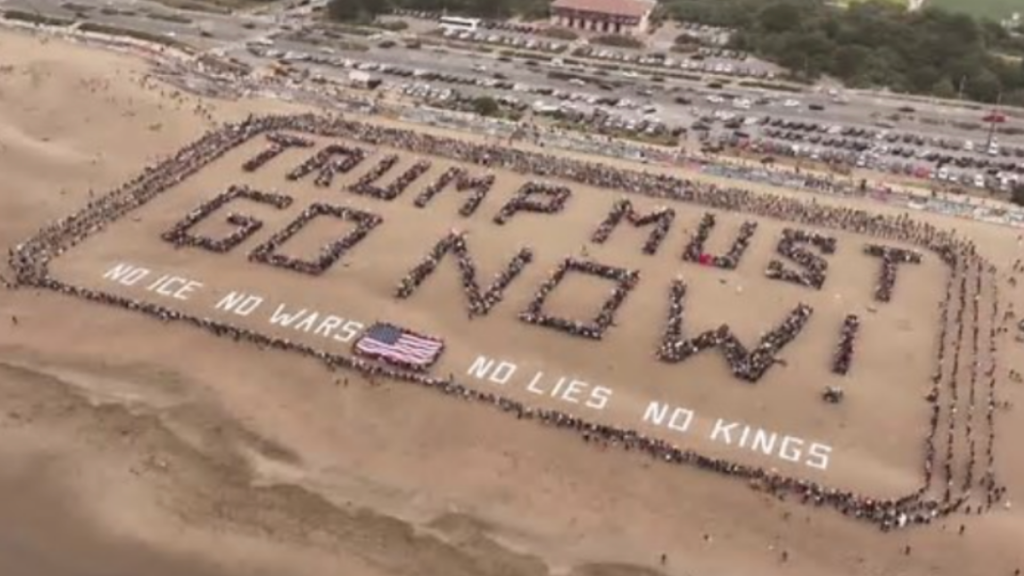
This weekend’s No Kings Day protests in San Francisco felt different from the two that preceded it. People were in shock about President Donald Trump’s war against Iran, and the energy spilled over beyond the protest itself.
The MindSite News team was on hand at the rallies in New York City, San Francisco and Berkeley, and we posted a photo essay from those events yesterday.
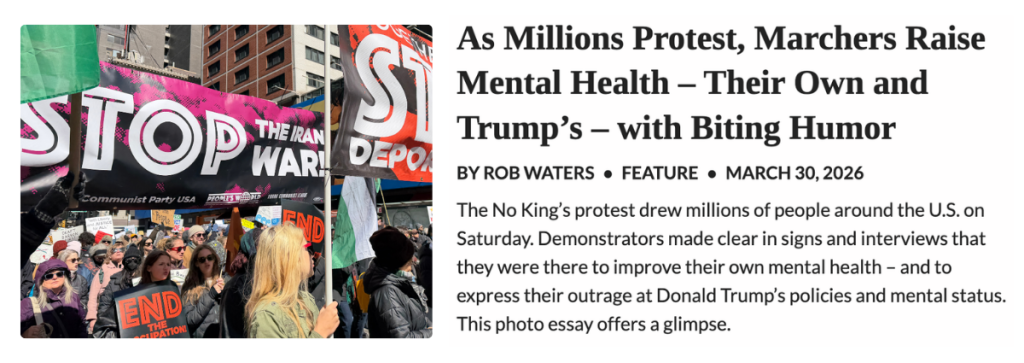
At a gyros cafe after the Civic Center Plaza rally, my husband and I chatted with protestors who poured out their fury and disbelief – over the war, ICE, Trump, federal cutbacks, the Epstein files and more.
Two demonstrators had braved the intense heat of inflatable costumes on a hot day, but said it was worth it to help keep people’s spirits up. “I just can’t believe this is where we are as a nation,” said one. “It is not like the country is in danger of becoming fascist – with Trump as president, it is fascist… and we’ve got to stop him.”
Other protestors denounced Trump for his “Epstein War” against Iran – an attempt, they say, to divert world attention from his relationship with the late Jeffrey Epstein – and the potential for the U.S. to mount a ground invasion of Iran despite the Trump campaign’s rhetorical opposition to “forever wars.” .
The flagship protest in Minneapolis drew an estimated 100,000 people. Bruce Springsteen performed “Streets of Minneapolis,” his new protest song released following ICE’s killings of Renée Good and Alex Pretti, and was joined by speakers including Joan Baez, Jane Fonda and Governor Tim Walz, who praised state residents for their “fierce” defense of democracy. “Don’t ever mistake our kindness for weakness,” he said.
“I have a message to our immigrant community here in Minnesota,” Walz told the crowd. “You are seen, heard, valued and loved. You add value to our state. You are part of the fabric of what is good about Minnesota, and I have to tell you, that is a hell of a lot more than I’ll say about anybody in the White House.”
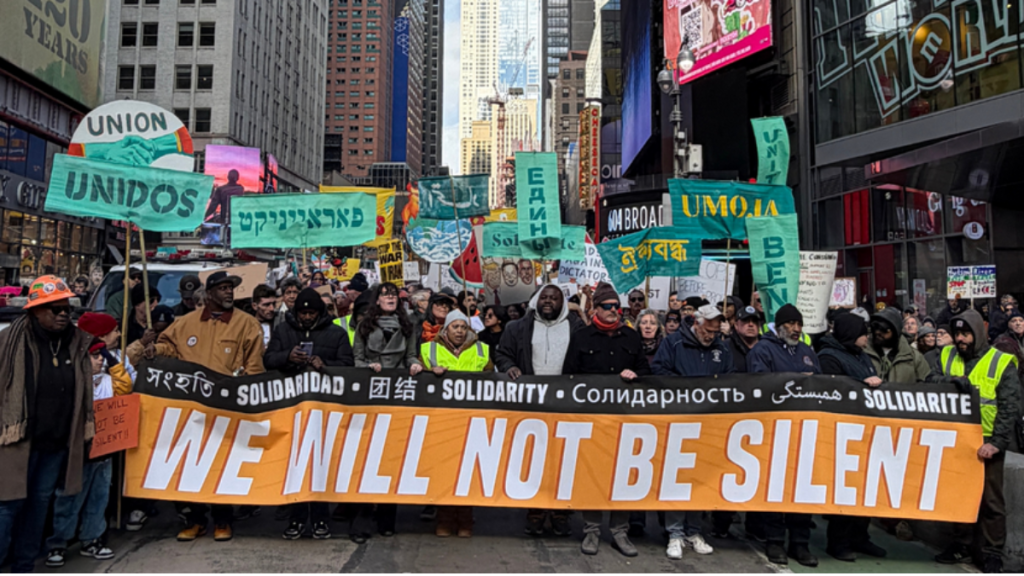
Anti-Trump protests took place in all 50 states, Puerto Rico and other US territories and in countries around the world including France, Portugal, Germany, Italy, Greece and the United Kingdom.
Even in the rather conservative Southern district where I grew up – now known as Sandy Springs, Georgia – things are changing.
“Many who haven’t (shared my views about Trump) in the past suddenly do, because the man is so unpopular and so dangerous,” Kathleen Meitzel, a resident of the Atlanta suburb, told the Guardian at a No Kings rally there. “Everyone is really beginning to see it if they haven’t already.”
A handful of rightwing counter-demonstrators disrupted the No Kings protest in Dallas, Texas. They were led by Enrique Tarrio, former chairman of the Proud Boys, and Stewart Rhodes, the founder of the Oath Keepers, both of whom were convicted and dispatched to prison for their role in the January 6, 2021 attack on the Capitol and then pardoned by Trump upon his return to office.
You can find more photos and write-ups of the No Kings Day rallies at CNN, NBC, The Guardian, The Los Angeles Times, The New York Times, USA Today and The Washington Post, among other outlets.
What ICE Detention Does to a Child
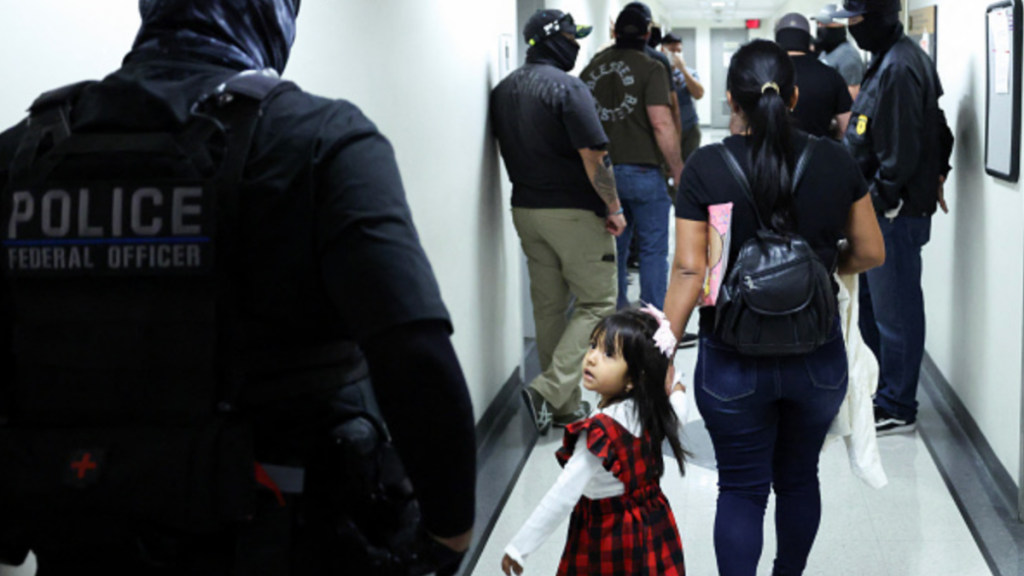
New York magazine ran a powerful story on March 18 on the traumatic condition of children in an ICE facility in Texas. Here’s the headline and the opening of the story.
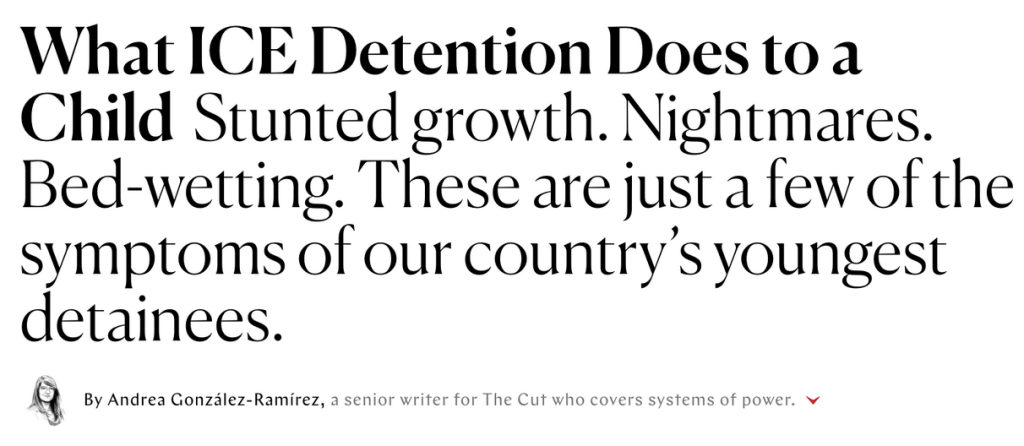
Days after his family arrived at the Dilley Immigration Processing Center in Texas last summer, 13-year-old Carlos began experiencing nightmares that would leave him screaming for his mother, Ingrid, as many as five times a night. After a week in custody, the teenager began wetting the bed – something he had never done before.
Ingrid was concerned that Carlos went from an active and happy child who would go out and play to one who was ‘stressed, anxious, and desperate’ and sleeping much more than what seemed healthy. ‘My son has changed a lot. I just want my son to be okay,’ she said. ‘I don’t want him to be overmedicated or to be suffering from insomnia. I want him to be a normal child.’
As Immigration and Customs Enforcement agents apprehend more children like Carlos every day, it raises a simple question that’s also one of grave moral concern: What does immigration detention do to a child’s mind and body?
“They are literally gambling with these children’s lives, and it’s just a matter of time before there’s a catastrophe,’ says Dr. Lara Jones, a California provider who specializes in pediatric critical care and who co-authored a letter demanding that the Trump administration release all children from immigration custody.”
Read the full report from writer Andrea González-Ramírez here.
In other news….
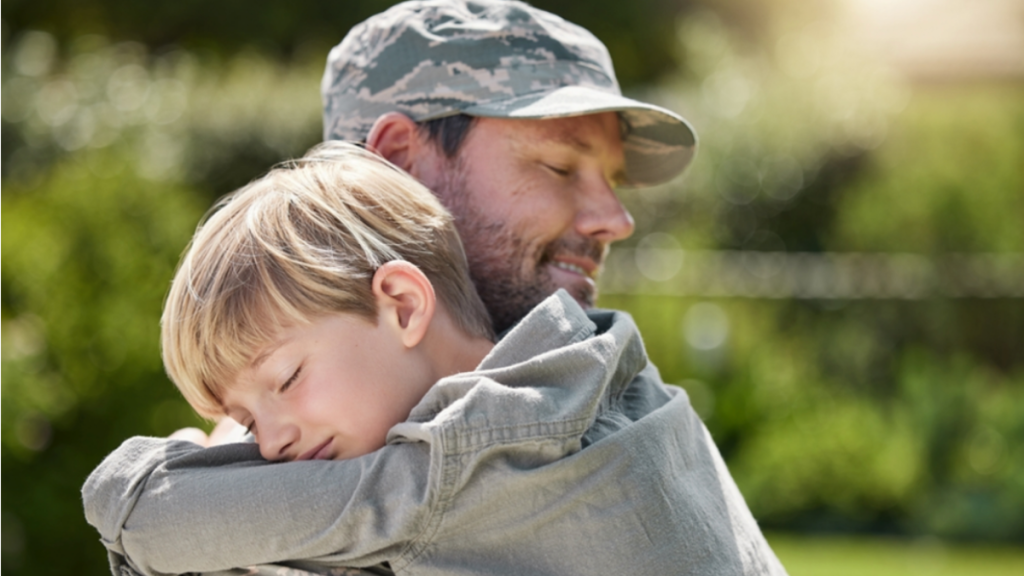
Wars don’t always end when veterans come home: One of the most difficult battles that many veterans contend with is the struggle against post-traumatic stress disorder (PTSD), whose symptoms often include intrusive memories, flashbacks, and nightmares; difficulty sleeping and concentrating; feeling angry or easily provoked; and losing interest in things they once loved.”
To better care for these former service members harmed by our wars, the Veterans Administration established the National Center for PTSD in 1989. In a short guest essay, Dr. Eugene Lucas of Wilkes University wrote about the center and some of its research. You can read his essay here.
ICE cruelty in detention centers mirrors racism in our past. In 1942, during World War II, Darrell Kunitomi’s family were one of many Japanese American families rounded up and sent to an internment camp simply for their ethnicity – “it did not matter that two-thirds of the imprisoned were native-born U.S. citizens.”
And though “the imprisonment of 120,000 people is rightly understood as one of the worst violations of constitutional rights in history,” today’s unaccountable ICE camps are “black holes,” where people “sometimes disappear.”
All this is cause for renewed concern, says Kunitomi, a former LA Times company historian, another instance of “the unfortunate hate and fear that seeps out of American skin when the heat is on.” He says that his family would be horrified by the Trump administration’s war on immigrants. Read the full piece in Golden State, a California-focused non-profit news company.
Two YouTubers in their early 20s risked arrest to film from Zorro Ranch, formerly owned by sex trafficker Jeffrey Epstein, reports the Santa Fe New Mexican.
Ash Alk sneaked onto the property on March 19, followed a day later by Jack Pembrook. He scrambled on the property and was scratched by barbed wire before unfurling a sign that said “Release the Files” in front of the Zorro mansion. Both had to make a dash for safety after security guards were alerted to their presence. Their videos on YouTube have drawn more than 4.5 million views to date.
Epstein survivors have also led social media and video campaigns pushing the Department of Justice to release some 2.5 million documents that have not been released, and more that were released heavily redacted.
Why do Gen X women seem to be suffering in silence? asks British writer Anita Chaudhuri in a piece for The Guardian. “By rights, we should be running the world by now. The first cohort to have grown up with widespread working mother role models, we benefited from free university education and the morning-after-pill.”
And yet, she notes nearly two-thirds of Gen X women – those born between 1965 and 1980 – report mental health struggles, according to a recent survey – and 90% of them have not sought any help. For her article, Chaudhuri spoke with a range of British women about the challenges they have endured.
The name “MindSite News” is used with the express permission of Mindsight Institute, an educational organization offering online learning and in-person workshops in the field of mental health and wellbeing. MindSite News and Mindsight Institute are separate, unaffiliated entities that are aligned in making science accessible and promoting mental health globally.

Author

Related Articles
Cornell Assault Prompts Parents to Talk With Their Sons
Sexual assault on campuses nationwide is still a grave problem.
The Unseen Toll: Depression, Anxiety Plague Black Women a Year After Being Fired by DOGE
When Trump cut DEI programs and allowed DOGE to gut the federal workforce, hundreds of thousands of Black women lost their jobs. Many are still reeling.
Exclusive: A Maternal Policy Expert Weighs in on Lindsay Clancy Mistrial
Policy expert Joy Burkhard discusses maternal mental health policy, postpartum psychosis misunderstandings, and new CA mental health parity laws.