Superstar Athletes Open Up at Project Healthy Minds 5th Annual World Mental Health Day Festival
Bringing together athletes, entertainers, and mental health experts, the 5th Annual World Mental Health Day Festival featured candid conversations on identity, screen time, and emotional resilience.
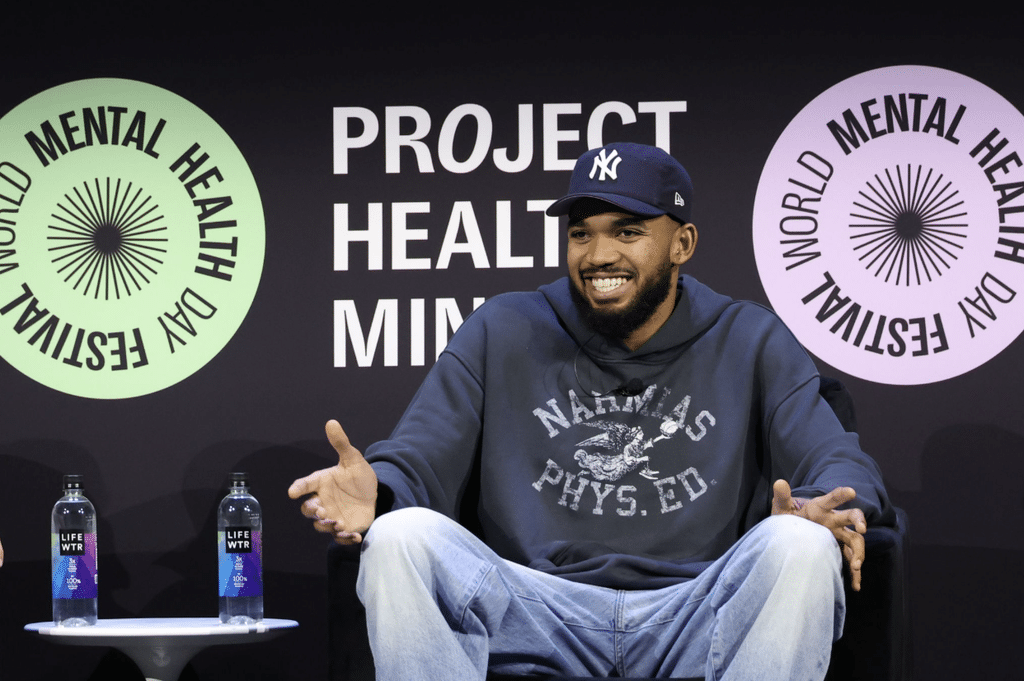
Months ago, Karl-Anthony Towns won his first NBA title with the team for which he grew up rooting, but he’s still grieving the death of his mother, who passed in 2020 of complications from COVID. The loss left him feeling hollow, and he even considered ending his basketball career. “I didn’t know if I wanted to do it anymore,” he said last Saturday at Project Healthy Minds’ World Mental Health Day Festival in New York City. “I had to really search within myself to hear the words she would tell me, and I had to carry it by myself now,” he told the audience.
Towns reflected on grief, resilience and mental health in conversation with Rich Kleiman, co-founder and CEO of the sports and entertainment company Boardroom and a new member of the Project Healthy Minds board of directors, the AP reported. Now in its fifth year, the tech nonprofit’s free, full-day festival brought entertainers together with mental health experts and advocates to discuss what organizers call the “defining public health issue of our time.”
Participants at the festival moved between several tracks, including Move, Connect, Create and Reflect. Activations ranged from a morning run or rooftop yoga to a conversation on fatherhood led by Joe Gonzales, founder of Brooklyn Stroll Club. Experts from New York University guided art therapy and certified instructors led meditation and breathwork sessions.
Leaning on athletes as spokespeople is deliberate. Project Healthy Minds CEO Phil Schermer told the AP that athletes shape how Americans picture strength, which puts them in a unique position to show that vulnerability belongs in that picture, especially for men. The nonprofit runs a free online marketplace to help people find therapy, psychiatry and support groups, and plans to lean further into sports in the months ahead.
On the main stage, social psychologist Jonathan Haidt, author of “The Anxious Generation,” warned that a steady stream of short-form video consumption leaves young minds no time to process what they take in. “Our creativity and our mental health require taking some stuff in and then having lots of time where you’re not taking stuff in,” he explained. “It’s the digital immersion, the cognitive fragmentation, the lack of time to process, the constant assault of quick, disconnected stuff. I think that is really causing massive cognitive destruction as well as mental health destruction.”
Haidt later warned: “Long stories are good, quick short videos are bad. That’s the simplest principle I can give you. I think short videos will turn out to be one of the biggest contributors to the declining test scores and the declining reading.”
But Rachel Janfaza, founder of the Gen Z research firm The Up and Up, added a hopeful twist. She said that young people used the recent FIFA World Cup and the New York Knicks’ historic championship run earlier this year to rebuild the in-person communities that they lost during the pandemic. “We’re seeing this swing,” she said, “and it’s really incumbent upon schools and employers and anyone who has a vested interest in helping this generation thrive to actually celebrate this.”
Identity and change were also major subjects of conversation. Actor and former NFL player Terry Crews spoke to anyone whose sense of self is tied to a job that’s shifting beneath them, encouraging listeners to treat themselves with the generosity of a kid trying something new. “Courage is not the absence of fear, but the recognition that something is more important than it,” he said. “The level of importance beats the level of trepidation or fear. And I learned how to turn fear into excitement.”
The name “MindSite News” is used with the express permission of Mindsight Institute, an educational organization offering online learning and in-person workshops in the field of mental health and wellbeing. MindSite News and Mindsight Institute are separate, unaffiliated entities that are aligned in making science accessible and promoting mental health globally.


Author

Related Articles

The Salon Experience on Rikers Island That Some Hope Could Scale Across the Country
How the Beauty Beyond Bars salon brought renewed confidence and hope to three women preparing for release from Rikers Island.

Students Keep a Roof Over Each Other’s Heads
Aggie House provides transitional housing for UC Davis students facing housing insecurity, offering peer support and low-cost rent.

‘Fighting government for something you’re entitled to’: Changing Medicaid work rules threaten coverage for millions
New 2027 Medicaid work requirements put millions at risk of losing coverage due to increased administrative red tape and recertification rules.