
For Gen Z and Alpha, Discomfort with Uncertainty May Trigger Arrested Development
Smartphone use seems to blunt teen’s enthusiasm for getting a driver’s license, working a paid job or going out with friends, expert says.

Greetings, MindSite News readers.
In today’s Daily, a new study finds that young adults are having a harder time coping with uncertainty, and therapists share techniques that can help. The importance of developing an emotional vocabulary and describing how we feel. Plus, research negatively links neighborhood disadvantage to early childhood development, and Pennsylvania lawmakers vow to pass legislation that protects LGBTQ+ youth.
But first, Oakland father and rap artist Justin “Jwalt” Walton is the youngest-ever Grammy nominee for Best Spoken Word Poetry Album at age 24. The record, “How Love Grows,” highlights his jazz, R&B, neo-soul and hiphop influences while celebrating every facet of Black fatherhood. “This album is for my kids,” Walton told KTVU-TV, “for the lineage of Black fathers that came before me, for anybody who’s ever had to figure out what love, family, and responsibility really mean.”
With information always available, young adults find uncertainty harder to bear
Before smartphones, plenty of plans came down to picking a time and place to meet, showing up and hoping for the best. But Gen Z (born between 1996 and 2010) and Gen Alpha, (2011 through 2024) haven’t lived that way, psychologist and San Diego State professor Jean Twenge told The New York Times — and that may be fueling their discomfort with uncertainty. We live in extremely uncertain times, and young adults have grown less tolerant of unpredictable or ambiguous situations, suggests a new meta-analysis published in JAMA Psychiatry.
Examining 132 studies involving more than 35,000 college students across the U.S. and Canada, researchers found that intolerance of uncertainty began its steepest rise around 2012, around the same time that smartphones became ubiquitous.
The shift is meaningful because intolerance of uncertainty is linked to several anxiety disorders. It drives “worry cycles” that make ambiguity feel like a threat, especially amid “increasing political polarization, economic uncertainty, political uncertainty and the rise of information technology,” said study co-author Katherine M. Keyes, an epidemiology professor at Columbia University. Twenge, who was not involved in the study, suggested that fewer rites of teenage independence like getting a driver’s license, working a paid job or going out with friends may also play a role. When smartphones keep kids at home, independence can start to feel even scarier.
In last year’s Stress in America survey, 68% of respondents said they’d grown used to living with uncertainty. But more than one-third of adults (34%) aged 18 to 45 said uncertainty was partly why they had put off planning for the future, compared with 24% of those aged 46 to 61 and 13% of those aged 62 to 80.
In addition, the survey noted, worry about the future also had a profound impact on younger adults and their parents: “Nearly two-thirds of those ages 18–34 (63%) and more than half of parents (53%) said they have considered relocating to another country due to the state of the nation.”
“Big sources of uncertainty that we don’t have control over are particularly challenging,” said Lynn Bufka, a clinical psychologist with the American Psychological Association. “One of the things that we try to help people think about is where are the places you do have some control, where you can assert something.” To practice coping with uncertainty, Bufka sometimes has clients put their worries in an imaginary box they can check once per day.
Alternatively, psychologist Kalya Castillo instructs clients to post affirmations like “I have been here before, I have experience in managing uncertainty” on their phones or fridges. She also teaches radical acceptance, embracing reality without fighting or avoiding it. “Accepting reality does not have to mean we have to like it or agree with it,” Castillo said. “It means we are choosing to preserve our energy for factors within our control.”
Why precisely naming your emotions is good for your mental health
Feeling “bad” is a hard problem to solve. Without a more specific word for what is wrong, people tend to fall back on whatever coping habit is closest at hand, even unhelpful ones, said Dr. David Kimhy, an associate professor of psychiatry at the Icahn School of Medicine at Mount Sinai. “If you feel anger, that calls for one strategy. If you feel guilt or anxiety, that’s a different strategy,” he told The Guardian. “But if all you know is that you feel bad, it’s hard to know what strategy to use.”
The problem is more common than you might expect. While most people start building an emotional vocabulary as children, about 1 in 10 experience alexithymia, an extreme difficulty or complete inability to identify their own feelings. It’s not a diagnosis on its own, but it is commonly associated with autism and can be a feature of conditions like depression and post-traumatic stress disorder.
At the other end of the spectrum is emotional granularity, a concept first identified by neuroscientist Lisa Feldman Barrett in 2004. It means naming feelings precisely rather than lumping them under broad categories like “happy,” “mad” or “sad.” Research ties higher granularity to lower levels of mental illness, better emotional regulation and a lower chance of relapse for people recovering from substance use.
Specific emotions carry more useful information, explained Katie Hoemann, an assistant professor of psychology at the University of Kansas. Someone who realizes that their sadness is really loneliness might reach out to a friend. Precise words also help other people understand how to offer support. “Your words aren’t just for yourself, so if you can tell someone: ‘Hey, I feel frustrated,’ or: ‘I feel disappointed,’ that’s more informative,” Hoemann said. “You’re communicating in a way that tells the other person how they can help you, and maybe how you can move forward together.”
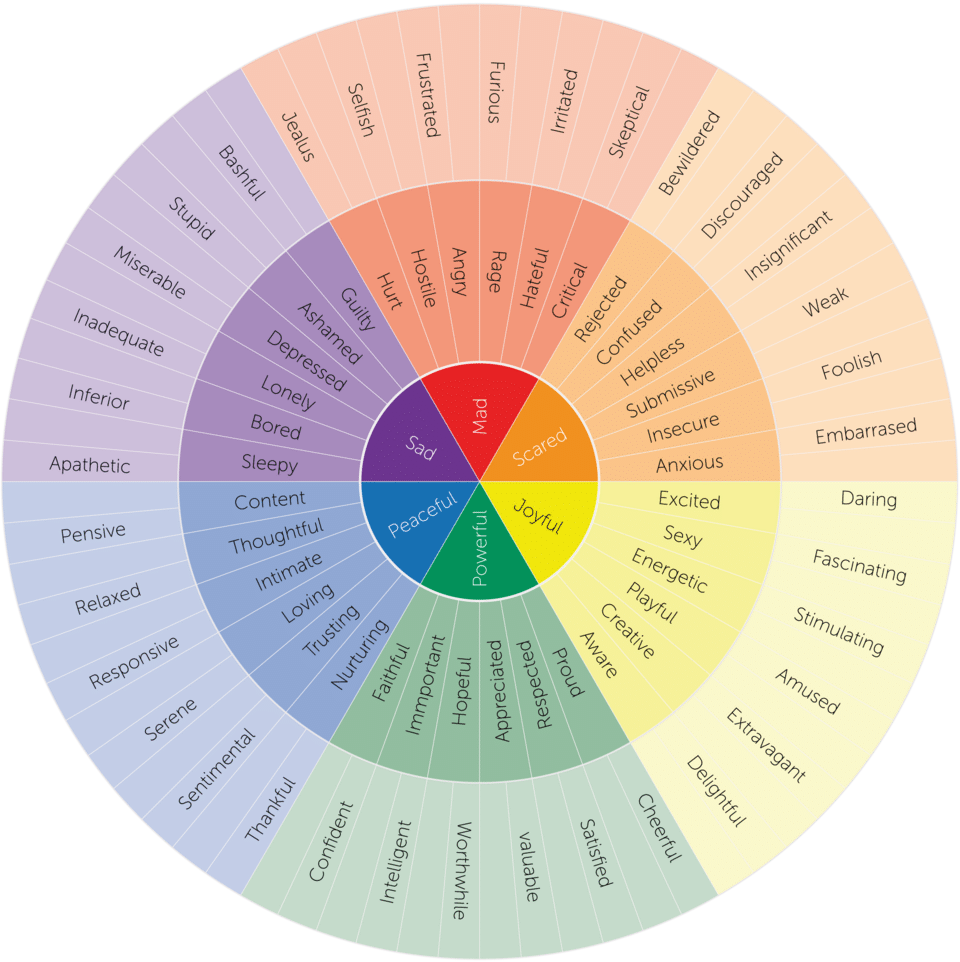
That’s where the feelings wheel comes in. Created by American psychologist Gloria Willcox in the early 1980s, it places broad feelings like happy, sad and angry at the center, then branches into more specific ones such as proud, remorseful or humiliated toward the edges. You’ve likely encountered one, voluntarily or not, as the tool has exploded in popularity and is now available on posters, spinning desk charts and even embroidered pillows.
The wheel, of course, is a starting point, not a substitute for care. People who struggle to name their feelings should work with a mental health professional. And for anyone prone to overthinking or too much emotional granularity, Hoemann cautioned against hunting for the perfect word every time. “There can be too much of a good thing,” she said.
Trans teen who died by suicide among those mourned at the Pennsylvania Capitol this year
Auggie Santiago’s photo was one of dozens placed in the Pennsylvania Capitol on Tuesday to remember the 55 known transgender and gender-diverse people in the U.S. who died from violence or suicide within the past year. That number included four from the Keystone State, the Pennsylvania Capital-Star reports. Ashleigh Strange, executive director of the Governor’s Advisory Commission on LGBTQ Affairs, said the true count is likely higher. “The numbers tell the story of a population in crisis, particularly for trans people of color who are targeted more often,” Strange said.
Auggie, a Bradford County teen who was just beginning to come out as trans, died by suicide in October. Their mother, Amy Santiago, said the family had struggled to find a therapist covered by their health insurance plan. When Auggie died, their first appointment was still two months away. “As a parent and as a person, I tried to be supportive, but that wasn’t enough. I’m not sure what would have been enough,” she said. “I do know that we as people — everybody — we need community, we need support, we need freedom, we need kindness and we need love.”
State lawmakers at the vigil said responding to that call is their job. “It became clear that there are some things that we simply cannot afford to hand off, and that we must take responsibility for as legislators ourselves,” Rep. Ismail Smith-Wade-El (D-Lancaster) said, recalling the six trans youth from Lancaster County who died during his first year in office.
In Pennsylvania, the Democratic-led House has passed the Fairness Act, a bill that would explicitly bar discrimination based on sexual orientation and gender identity or expression, in each of the last two sessions. With Democrats taking control of both of the state’s legislative chambers next year, party officials say passing that bill will be a priority, along with a slate of related bills that had stalled in the Republican-controlled Senate.
In other news…
Where kids grow up matters: The neighborhood a child grows up in may affect their emotional development as early as infancy, according to a new study in JAMA Network Open. Researchers at the University of Pennsylvania and Children’s Hospital of Philadelphia followed 249 Philadelphia-area mothers and their children from infancy to age 4, scoring each family’s neighborhood on several measures of disadvantage. Children in more deprived areas were about 2.4 times as likely to be referred for monitoring or early intervention. They were also about 40% more likely to have a developmental or behavioral concern noted in their medical records. Those links held even after accounting for family income and mothers’ anxiety.
The link was stronger for children from Black or multiracial households, who also lived in significantly more deprived neighborhoods. The authors tie that pattern to “structural and systemic inequities,” including decades of segregation and disinvestment. They also note that while their study was small and limited to Philadelphia, and that parent reports and medical records can reflect bias, the findings reflect a critical need for widespread investment in safe streets, green space and high-quality child care to help more children thrive.
The name “MindSite News” is used with the express permission of Mindsight Institute, an educational organization offering online learning and in-person workshops in the field of mental health and wellbeing. MindSite News and Mindsight Institute are separate, unaffiliated entities that are aligned in making science accessible and promoting mental health globally.


Author

Related Articles

Second Suicide at US Health Agency Reflects 2 Years of Workplace Trauma
The Health and Human Services department has been roiled by suicides and workplace trauma since Robert F. Kennedy, Jr. took over.

Trump’s Medicaid work requirements delayed but on the way
A closer look at the secret payouts settling social media teen lawsuits, plus the Trump administration’s six-month delay of federal Medicaid work requirements.
Why SNAP Cuts Make It Harder to Buy Healthy Food
SNAP cuts make healthy food harder to afford for families. Plus, a Delhi teen fights menstrual stigma and improves access to period care.
