
You Cannot Make Football Safe for a Child’s Brain, but You Can Make It Safer
Football cannot be made completely safe for a child’s brain, but smart choices can lower the risk. Discover how flag leagues and reduced contact protect youth.
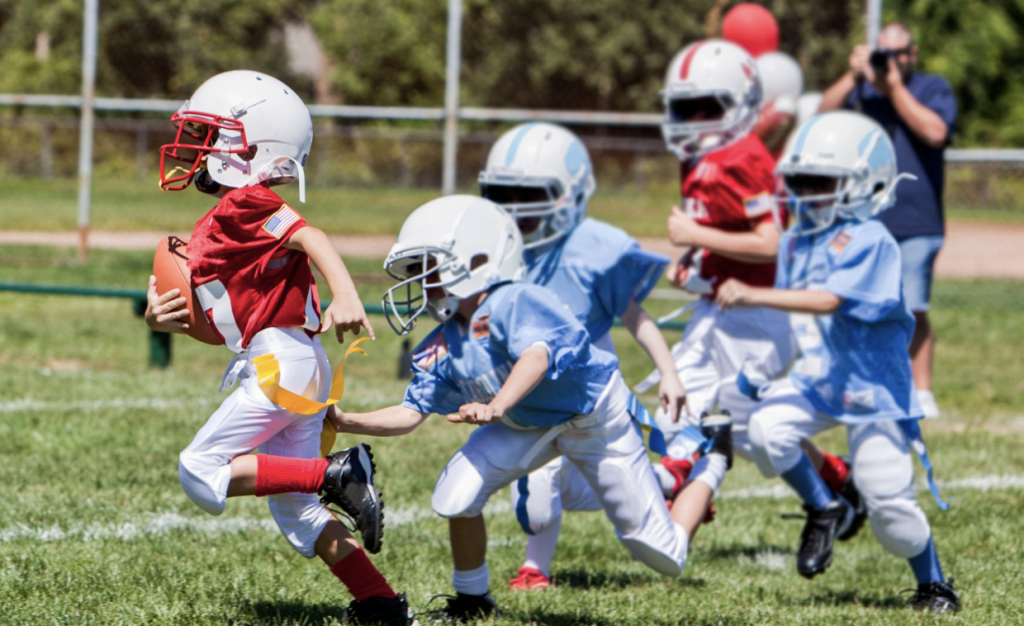
Football season has begun and I, like so many Americans, am preparing to watch. In fact, I’ve already signed up for the fantasy league my cousins and I have run for nearly 20 years. It’s a ritual about which I feel more ambivalent with each passing season, as I learn more about the unavoidable risks the sport poses to its players’ mental health. Every fall, parents of football players sit with a heavier version of that unease. On one side of the scales, they weigh what the game gives their child: friendships with teammates, the discipline of a training routine, the community that grows among families gathering on a brisk Saturday morning. On the other lies a potentially life-threatening disease with no known cure.
CTE (short for Chronic traumatic encephalopathy) is a neurodegenerative disease caused by repeated concussive and subconcussive blows to the head. Though most often associated with football, it has turned up in athletes across other sports where repetitive blows are common, including boxing and some martial arts, ice hockey, rugby, soccer, wrestling and bobsledding.
For years, CTE was understood as a disease of the aging professional — diagnosed in the brains of Hall of Famers whose lives unraveled decades after their last snap or tackle. But the New York Times recently reported on a study of former NFL players who died between 2016 and 2021, with astonishing results. Of the 878 who died in that span, the families of 235 donated their brains for examination, and researchers found CTE in 215 of the donated brains — enough to conclude that at least one in four of all of the deceased players had the disease. The real figure is almost certainly higher: CTE can only be diagnosed post mortem, and the other 643 brains were never examined.
Even more unsettling is the finding that, in 2023 Boston University researchers, examined the brains of 152 contact-sport athletes who died before age 30 and found that over 40% had CTE. Most of them had played their sports at the high school or college levels.
For parents of children who love the game, the grim finding carries a strange sliver of hope. “We know what’s causing it,” said Dr. Daniel Daneshvar, the chief of brain injury rehabilitation at Spaulding Rehabilitation Hospital and a professor at Harvard, who led the 2026 study, which was published in BMJ. “It’s a neurodegenerative disease where we know and have complete control over the risk. And understanding the extent of that risk is one of the steps into making sure that we can mitigate and decrease that risk.”
Families whose children aren’t going to give up the game have to accept that the protection isn’t in the equipment — no helmet, mouthguard or supplement has been shown to lower CTE risk, no matter what the box promises. Safety lies in limiting exposure to blows to the head, and the two levers that matter most are simple: fewer years of contact and fewer hits within those years. That means delaying tackle football in favor of flag leagues for younger kids, and pushing for safer practices without full contact. The Ivy League, for instance, banned full-contact practices years ago, and even the NFL has moved to limit them in order to cut down on injuries, including head injuries.
The rest is vigilance. Be wary of any coach or parent with a “play through it” mentality. Brain injuries don’t announce themselves like broken bones, and kids must feel safe speaking up. Young players are especially vulnerable to second-impact syndrome, when a second blow lands before the first has healed and the brain swells past what the skull can hold — a chain that can sometimes end in coma or death.
None of these makes the sport safe, but It does make it safer. For a parent doing the math in the bleachers, that difference is the whole game.
The name “MindSite News” is used with the express permission of Mindsight Institute, an educational organization offering online learning and in-person workshops in the field of mental health and wellbeing. MindSite News and Mindsight Institute are separate, unaffiliated entities that are aligned in making science accessible and promoting mental health globally.


Author

Related Articles

Discharged to Die: Doctors and Hospitals Across the U.S. Fail to Treat Patients With Addiction
An investigation into hospitals turning away patients with severe addiction, and the stigma inside U.S. medicine that leaves most people untreated.

Scores of Women Witness the Trial of Lindsey Clancy, Many Believing ‘She Could Be One of Us.’
Inside the Lindsay Clancy trial, where mothers nationwide are watching a jury weigh insanity vs. guilt and asking what the mental health system owes them.

Before Lindsay Clancy, There was Latarsha Sanders
As jurors deadlock in the Lindsay Clancy trial, revisit our interview with Yvonne Abraham on Latarsha Sanders and how race shapes insanity defenses.