
Second Suicide at US Health Agency Reflects 2 Years of Workplace Trauma
The Health and Human Services department has been roiled by suicides and workplace trauma since Robert F. Kennedy, Jr. took over.

Greetings, MindSite News readers.
In today’s Daily, another tragedy within the Department of Health and Human Services suggests a mental health crisis among its workers under Secretary Robert F. Kennedy Jr. Women caring for aging parents say the viral “Saturday Night Live” sketch “Sister” is painfully accurate, and a new survey finds that women with autoimmune diseases wait years longer than men for a diagnosis — often because their symptoms are initially dismissed as psychological.
But first, a reminder that our children will practice the habits we model for them.
And also, a reminder that MindSite News is looking for a part-time community engagement coordinator in the Bay Area. We look forward to hearing from you.
Under RFK Jr., a mental health crisis envelops HHS

The recent suicide of a federal employee has exacerbated what one former official called an ongoing mental health crisis throughout the Department of Health and Human Services. The employee, who worked at the Substance Abuse and Mental Health Services Administration that runs the 988 National Suicide and Crisis Lifeline, died at SAMHSA headquarters, according to two people who spoke with Government Executive. “We are deeply saddened by the death of one of our colleagues,” a SAMHSA spokesperson said, adding that providing relevant support to affected staff is an agency priority.
Still, the death has agitated wounds for HHS workers that are still reeling from other recent workplace traumas. In March 2025, a child and maternal health issues specialist at the Centers for Medicare and Medicaid Services’ Innovation Center in Maryland died by suicide. Then in August, there was a shooting at the Centers for Disease Control and Prevention in Georgia.
“Feds have been continuously attacked for a year and a half, and it is taking a toll on them,” said Jonathan White, a mental health clinician specializing in workplace trauma who left HHS last year. “I’m not suggesting — because there’s no way of knowing — whether this is the central factor in (last week’s) suicide. But it is absolutely, I can say with certainty, the defining feature of the way that this news has spread through the PHS (Public Health Service) and HHS. It is becoming a symbol of what this administration, and particularly Secretary Kennedy’s team, has done to workers in HHS.”
SAMHSA experienced the deepest cuts of any HHS agency last year, losing more than half its staff amid the Trump administration’s reduction of the federal workforce. The department has also enacted new restrictions on reasonable accommodations for employees with a disability or medical condition. And just last month, HHS began closing accommodations requests over missing paperwork — despite employees holding proof that the documentation had been properly submitted.
“The people who could leave all left,” White said. The employees who remain, he added, face “constant orders to violate scientific integrity and undermine science … the constant messages of blame and fault from the secretary that they are the reason Americans are sick, the constant climate of fear about the next [cuts].”
“There is a mental health crisis for HHS feds right now, both those still inside government and those who’ve been displaced,” White said. “And for those inside government, it’s quite severe.”
SNL’s “Sister” sketch hits home for women caring for aging parents
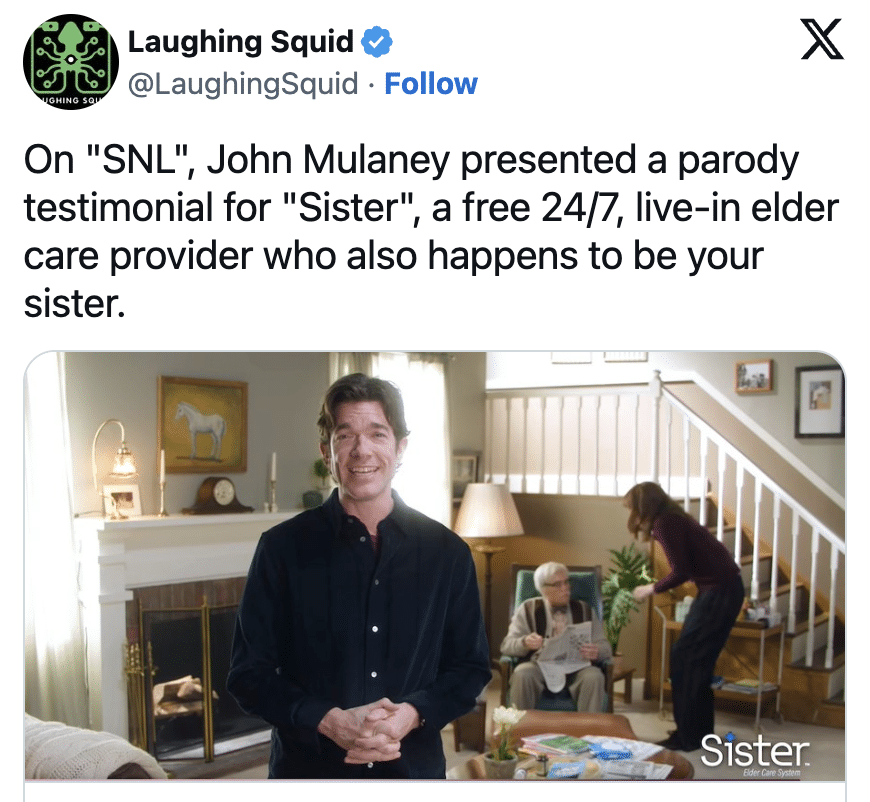
During an especially demanding period of caregiving, Jodi Bondi Norgaard lamented the work to her husband: “For a good portion of my life, I’ve taken care of someone or something: our kids, our dogs, our home, and now I’m taking care of my mother. I’m exhausted. I just wish someone would take care of me, even just for a little while.” As quickly as the words escaped her lips, she felt a rush of selfishness — mimicking the experience of many women caregivers who watched “Saturday Night Live’s” viral “Sister” sketch last weekend, Norgaard writes in an essay for Ms.
The satirical service ad pitches a free, live-in elder care service for men that’s really just…your sister. Watching it stirred laughter, tears and rage, Norgaard writes. As the eldest daughter and her mother’s main caregiver for the past six years, she immediately saw herself on screen. With his sister handling everything, comedian John Mulaney’s character no longer has to worry about their father. “I can get back to my life and the stuff I like to do,” he says. That line especially stung, Norgaard writes, because it rang true. “Sister,” meanwhile, is never without work or worry. She carries the burden to her job, to bed and even on vacation. “You can leave town, but you never completely leave the worry behind,” she writes.
The numbers show that Norgaard is far from alone, as do the 14,000 comments under one of SNL’s Sister social media posts. Of the nation’s 63 million adult family caregivers, 61% are women. About two-thirds of them report moderate to high emotional stress according to a report from AARP and the National Alliance for Caregiving. With women already spending nearly 50% more time on everyday household tasks, caregiving adds to the unpaid labor. Part of the reason is social conditioning, New York City-based therapist Kim Hertz told HuffPost. “These roles develop over the lifespan and are rarely discussed or questioned,” she said.
But being a good daughter doesn’t require sacrificing your life, insisted Jennifer Chappell Marsh, a marriage and family therapist in San Diego. She hopes that the sketch will help initiate necessary conversations between siblings with aging parents about the roles they’ve taken on and the responsibilities they can share. “For women, I’d say start paying attention to how often you’re making excuses for other people’s lack of effort,” Marsh said. “Ask yourself, ‘Are they really unable to do these things or have they just gotten used to you taking care of everything?’”
Left unspoken, many women grit their teeth beneath the load, keeping their feelings of resentment silent, Norgaard writes. She wants families to share the work and policymakers to back caregivers with paid family leave, caregiver tax credits and access to respite care. Because “Sister” shouldn’t be expected to handle it all — even if she could.
Writing obituaries for deaths by suicide
New York Times writer Clay Risen, part of the Obituaries desk at the paper, recently reflected on his job and the Times’ evolution on covering suicide in a poignant essay. Although families are more open to talking about suicide, some are still reluctant to broach the subject and some avoid it entirely.
This isn’t unexpected; for many years, obituary reporters were just as uncomfortable. For much of its history, the New York Times’ obituary desk either hid suicide behind euphemisms like “died suddenly” or covered it with sensational, moralizing headlines. That approach reflected an era when suicide was widely seen as a moral failing or as madness, not a mental health issue. When Ernest Hemingway died in 1961, for instance, the Times reported his death as an accident following the account that his wife, Mary, first gave authorities. But five years later, she confirmed to the paper that he had died by suicide after years of mental turmoil. “In the very first day I could not accept the fact,” she said. “Later I admitted it to myself. I spoke about it to friends.”
Her decision to publicly acknowledge his suicide, in the manner that she did, was radical for the time. Rather than condemn Hemingway, she placed his death in the context of mental health struggles and gave voice to the people who loved him, which psychologists say may help deter people considering self-harm. Still, the shift in media coverage has been far from steady, despite evidence that reporting on suicide carries real risk. Social scientists call it the Werther effect after Johann Wolfgang von Goethe’s 1774 hugely influential novel “The Sorrows of Young Werther,” which ends with the protagonist’s suicide. The book was followed by so many copycat deaths that critics urged Goethe to add a warning for readers.
It was not until after a 1989 federal workshop that health officials adopted standard reporting guidelines, including a caution against blaming suicides on a single cause. Coverage done with that kind of care can honor one life while possibly helping to protect others. “Journalism and reporting of suicides can actually be part of the solution,” said Dr. David Jobes, a professor of psychology at the Catholic University of America. “It brings into the larger public an awareness that this is a public-health issue.”
Still, old taboos die hard. As Risen concludes, “There is more openness about discussing suicide now. But the topic remains tinged with shame, taboos, moralizing and even romanticizing, in a way that other kinds of death are not.”
In other news…
Not all in their heads: Many women with autoimmune diseases are told their symptoms are simply psychological, according to a recent survey led by British researchers, NBC News reports. The survey, published in eClinicalMedicine, included 6,607 participants, 91.2% of whom were women. Women waited about four years for a diagnosis of conditions such as lupus or rheumatoid arthritis, while men were diagnosed in three months to a year. “Women in particular felt not listened to or not heard or not believed by their medical professionals,” said study co-author Sydnae Taylor, a doctoral researcher at the University of Oxford.
Many autoimmune disorders share early symptoms, including fatigue, low-grade fever, anxiety and depression, which makes them hard to pin down. Women’s symptoms also often develop over time, said Dr. Saira Z. Sheikh, director of the UNC Rheumatology Lupus Clinic in Chapel Hill, North Carolina. Misdiagnosis is even more likely when symptoms such as pain, fatigue or tingling do not show up in blood work, Taylor said. Still, Sheikh said, “we shouldn’t assume that women’s symptoms are psychological simply because the initial investigations are inconclusive.”
The name “MindSite News” is used with the express permission of Mindsight Institute, an educational organization offering online learning and in-person workshops in the field of mental health and wellbeing. MindSite News and Mindsight Institute are separate, unaffiliated entities that are aligned in making science accessible and promoting mental health globally.


Author

Related Articles
Trump’s Medicaid work requirements delayed but on the way
A closer look at the secret payouts settling social media teen lawsuits, plus the Trump administration’s six-month delay of federal Medicaid work requirements.
Why SNAP Cuts Make It Harder to Buy Healthy Food
SNAP cuts make healthy food harder to afford for families. Plus, a Delhi teen fights menstrual stigma and improves access to period care.

Nebraska Roll-Out of Trump Medicaid Rules Is Chilling
Nebraska’s Medicaid work requirements are already costing people coverage. Plus, physicians face a mental health crisis as fear keeps many from seeking help.
