
American Madness: Fighting for Patients in a Broken Mental Health System
As a psychoanalyst, Alice Feller had a close-up view of the deterioration of mental health care in California. Her new book seeks to change that.
An interview with Dr. Alice Feller
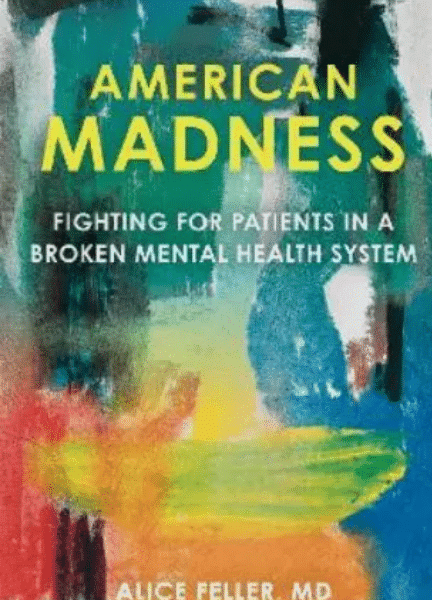
American Madness, Dr. Alice Feller’s memoir released this May, belies just how good she is at listening. A retrospective march through her career in California’s psychiatric landscape, American Madness depicts Feller’s journey to help patients with severe mental illness, including schizophrenia, bipolar disorder and major depression. The book is a series of anonymized vignettes with patients who left lasting impressions, most often because of the reflections they prompted in Feller about the larger health care systems at play – and where those systems have fallen short.
Dr. Feller has been in practice since she graduated from medical school in 1977. After her residency training and a two-year physician fellowship in substance abuse treatment at a VA center in San Francisco, she spent five years at Kaiser Oakland, where she was hired to help the medical center improve its substance use program at the height of the crack epidemic.
From Kaiser she went on to private practice. She’s built a career in psychiatry and psychoanalysis on her listening, and in our interview about her book, she was empathetic and extraordinarily present. She also came armed with many ideas to fix our flawed mental health system, some of which she’s shared in op-eds and letters in CalMatters, the New York Times and the San Francisco Chronicle, as well as scholarly journals.
From her work in the late 1970s as an intern in a psychiatric hospital in San Mateo County, Feller recalls the contrast between this well-staffed, collaborative ward and the disjointed, ineffective cycle from emergency rooms to homelessness that patients with serious mental illness often face today – something due to an erosion of resources for psychiatric treatment, resulting partly from the “16-bed rule,” which forbade the use of federal funds to pay for treatment in facilities with more than 16 beds in 1965. San Mateo County was a rare exception to the rule, she writes.
The 15-bed law was designed to prevent the reemergence of large, sometimes abusive asylums and encourage community-based care while also limiting federal spending. But what followed, Feller writes, was an elimination of inpatient psychiatric and substance abuse services for “all but the very young, the very old, the very wealthy, or those with families willing and able to make huge sacrifices.” Money, she says, became the driving factor in all aspects of care.
A federal waiver lifted that limit in 2017 for California facilities treating substance use disorder and added coverage for short-term residential mental health treatment in 19 of California’s 58 counties as part of a pilot that will run through 2026. But in much of the state (and nation), the IMD exclusion still limits treatment for mental illness.
In American Madness, Feller writes about the patients and deteriorating practices that continue to haunt her. She left public health and began her own private practice in 1989, completing the 10,000 hours of listening training needed to become a psychoanalyst.
In 2017 she returned to part-time public mental health care in addition to her private practice and was met with a rude awakening. First at Oakland’s Community Support Center and then at a “full service partnership” that provided intensive services to people with serious mental illness run by the city of Berkeley, Feller witnessed a system that was underfunded and deeply fragmented. She recalls board-and-care housing facilities unable to locate their own residents, gamesmanship in the way diagnoses are presented to insurers, and the continual struggles with racism and housing insecurity that her patients and their families faced.
She retired in 2023 and finally has the space to reflect on it all. In an interview over coffee recently, she shared those reflections. The conversation has been edited for length and clarity.
Throughout your clinical career, you’ve also been interested in writing. Were you collecting these stories intentionally throughout your career?
I’ve always written. I was a Daily Cal reporter when I was here at UC Berkeley. When I got this job at the Oakland Service Center I just went home and wrote things that I was impressed by, sometimes things that moved me, the patients or their families. But mostly I started writing what shocked me. I didn’t really mean it to be a book. I was just writing. I envisioned it as just writing to myself, these outrageous things, just as a way of expressing it.
How has writing this book impacted the way you think about clinical work?
It makes me want to work in a good system. I spent a lot of time thinking about early intervention for psychosis. And I think it would be fun to work in a real clinic where they really did that, and we could monitor patients over time and see them get better, get to know their families. That would be a fun job.
You have said that the U.S. needs single-payer insurance, a healthcare system in which only the government pays for health insurance and in which everyone receives coverage.
We need single-payer. Really, it’s just ridiculous. We spend way, way, way too much money funding the insurance companies and the pharmacy benefit managers and all that stuff. I think that really is the first thing we should do, which is what other civilized countries are doing. England has national health care. Canada has something similar.
And we need more time. Serious mental illness is like cancer; we really need to treat it absolutely fiercely from the beginning, especially schizophrenia. It helps with other psychotic disorders, too.
A patient you called Brandon was prescribed antipsychotics that seemed to do more harm than good before he reached your care at the service center in Oakland. You write with dismay about being unable to reach his former treatment facility, a corporate-owned place you call Sierra Sunrise, to get any records.
Corporate-owned treatment facilities can be a problem. Some of them do good work, but they [often] take shortcuts to save money, particularly. A lot of their psychiatric interviews are short, and many provide treatment by telehealth – the person’s not there – which I think is just really inferior care. Maybe it’s all they can do, because it’s hard to hire and all that stuff. But I think everyone is so under the gun to get money, because of our system. I’d love to really immerse myself in a different system, you know, a different country. Maybe go to Canada and spend some time, or England or something like that, and see how it works.
For patients who are psychotic, you need to hear from the family. The family is their main anchor. Their best friend. And the family can tell us a lot that we’re not getting from the patient.
Dr. Alice Feller
We don’t have an example in front of us about how these things actually work. We know that they pay a lot of taxes. But I worked at Kaiser for five years. And it’s so different there, because it isn’t all about how much money it’s going to take (although sometimes it takes a huge amount of money). But the doctors and the other patients talk to each other about what’s needed, whether it’s worth doing this or whether that’s the thing. Money doesn’t come into it.
Is that because of the billing structure? Right now our system uses “fee for service” billing, meaning providers are paid for each visit or service they perform individually.
Exactly. Whereas at Kaiser, a patient will pay a monthly fee. For that we’re guaranteed. I think it’s pretty good.
There’s a concern, largely voiced by lawyers, disability rights groups and peer support groups, that psychiatry and locked institutions like hospitals are harmful. It sounds like you believe that insurance and corporate control over health care is the bigger problem. Is that accurate?
Definitely. Oh, yeah. I think that there’s a kind of a political wash over the whole question. One Flew Over the Cuckoo’s Nest — people think that that’s what inpatient hospitalization is like. In my experience, it was never like that. Sometimes people are just unaware that they’re sick. And they’re not really able to give themselves the self care that they need, without some kind of strong push.
And we don’t keep people. Right now, we [rarely] keep people at all because we don’t admit them because we don’t have beds. But when I was working as an intern, we didn’t keep people for longer than a week or two weeks at the longest. Then we found homes for them or sent them back to their homes. We didn’t have the homelessness situation that we do now.
Do you think it’s possible for someone experiencing a state of psychosis to give informed consent?
No, I don’t. I think that if you are in the grip of a psychotic episode, and you think that everyone’s out to harm you, which begins to happen after a bit, it’s impossible for you to judge whether any kind of treatment would be useful for you. If you’re a civil rights lawyer, you can say, “People may have every right to refuse,” but the result of that is just terrible. For everybody, but especially for the patient. So you can say, “Well, come to our wonderful outpatient services,” but they’re not going to do that. Because they think there’s nothing wrong with them.
By definition, a state of psychosis deters people from seeking help. Erring on the side of informed consent when someone experiences psychosis doesn’t work with optional outpatient programs because they are likely to opt out of the program and decompensate.
Denial about any other type of disease, like cancer, is plainly problematic. Why do you think denial is such a strong problem for severe mental illness?
It’s a good question. There’s so many reasons. In the beginning, it’s part of the illness. And more often than not, it gets to them rather quickly. So it seems like denial, in someone who’s not psychotic. And then there’s psychological denial. Who wants to think that you’re schizophrenic? You’re going to live a life of being different from everybody else. Being impaired, being left out. So it’s very hard. It takes a while.
How did you coach families through this acceptance process?
I don’t know that I’ve coached families exactly so much as listened to them. Some of them, the mothers, know exactly what’s going on with their kids. They’ve turned their lives over to taking care of their kids and it’s amazing. My hat’s off to them. If they ask for tips or something, then of course, I say something that I think is helpful. But I don’t think I would venture to say something about what they ought to do.
You write about families as patients’ best advocates, and the importance of community support outside of a therapist. How do you balance trust and confidentiality when it comes to needing a village to help?
Especially when you’re talking about family, I think it’s tricky. Most people, I feel, tend to opt for keeping the family out. This is confidential, you know, stay over there. We’ll call you if we need you. I think that’s absolutely wrong. For a patient who is psychotic, you need to hear from the family. The family is their main anchor. Their best friend. And the family can tell us a lot that we’re not getting from the patient.
You can always listen to the family. And I think that’s important. I think that’s not very well understood. I think there’s a kind of anti-family feeling in the profession.
You mention anti-psychiatry psychiatrists in the book. There’s a lot of resistance to medication, a lot of people who don’t believe in that method of treatment.
I think it’s traumatic to have these illnesses. I think maybe a lot of people have gotten stuck in sort of ‘there’s nothing wrong with me, it’s just a label, it’s just a kind of oppression, they want us to take these drugs that are evil mentally.’ And they are difficult drugs. We really have to work with somebody.
I think that people have been left out of the rest of society by their illness. It’s hard to succeed in school when you’re psychotic, or anything else. And I think that that’s such an injury that a kind of soothing thing in response is to say, “They’re wrong, we’re right.”
I feel very strongly about it, though: I think the anti-psychiatry position is destructive. I think it’s kind of the same political voice that has always been against locking people up.
As a therapist, you have to be really, really careful. Super careful. Gentle with people, not roll over them. You may be right, but that doesn’t help them. As a patient, if someone points out what you’re doing wrong, or a feeling that’s wrong, there’s the wrongness of you. That’s hard. You may be right, but that doesn’t help them.
You paint scenes where you hold back on telling a patient that you think they’re experiencing hallucinations or delusions because you’ve started to gain their trust and you don’t want to sabotage that. That’s what seemed to happen with a patient you call Chris.
When you’re trained to be a therapist, the watchword of what you say is timing and tact. Chris suffered from psychosis. I had a wonderful chance to actually work with him in a way that really works. And that was great. But it took a long time for him to see it. And it’s a hard thing to accept, that something is so basically wrong with your mind. We are our minds.
At the facility you call Dry Valley, you were surprised to see rampant upcoding – submitting diagnoses severe enough to make insurance reimbursement likely. This is widespread in mental health.
You need to have the right diagnosis. At Dry Valley, we didn’t know. I didn’t know. Everything said schizophrenia. Maybe it was, but often it wasn’t. The upcoding was always aimed at Medi-Cal. It wasn’t aimed at keeping someone. Because we weren’t in that space. We weren’t trying to send people into the hospital no matter how much they needed it, because it’s a losing cause. If I write another book, it’s going to be medicine and money, money and medicine.
It seems like the willingness to be surprised has carried through your work as a clinician and as a writer. Is it something that you intentionally cultivated?
I’m just a person who can be surprised. [Laughter.] I feel strongly about pursuing the truth. honoring what really is even if it’s not what I thought.
Compassion fatigue and secondary trauma come up a lot for both psychiatrists and journalists. How do you take care of yourself?
Well I have a husband, I have friends. I have a daughter. I like to garden. I play the piano, I like music. I guess that’s how I take care of myself. I don’t feel myself worn out by the stories I hear or by the patients, so much as by the impossible system. Because it doesn’t have to be that way. It wasn’t, in my early experience. It could be so much better, and it’s frustrating. That’s the fatigue that I have.
You write, “The other part of psychoanalytic listening is listening to ourselves. For instance, being aware of what we’re afraid of, what offends us, or what we’re wishing. We have to discern which it is. And we have to tolerate uncertainty.” How do you tolerate uncertainty?
I don’t like it. Tolerate is a good word.
What advice would you give to a young person who’s just dipping their toes into the world of telling these stories?
Become really familiar with people who are struggling with these diseases, and the people who work with them and their families. All those people have something really interesting to say.
You open the book by sharing about your father’s explosive outbursts, unpredictable rages and threats of suicide. How did that influence your career path?
Yeah. Well, obviously, that made me really aware of mental illness, and what it means. He didn’t have an official, serious mental illness. But it dominated our family. We were all kind of screwed up by it. So [psychiatry] seemed like the most important part of medicine to me and the funnest part.
You open the book with the story of a childhood quest for the symptoms of psychotic disorders and close it with the answers you had initially sought, plus a list of suggestions for change in the epilogue. Can you tell me about that choice to have these bookends?
I didn’t think of it that way. It’s more like, this is who I was as a teenager. And this is who I’ve become as a practitioner, and this is very important. If you’re going to say that we need to do early intervention with people who have psychotic illness, you have to figure out: who are the people? Especially because it’s important to do it early. There’s so many people who go into crisis, they get taken to the ER for this reason or that. And they’re not going to have a psychotic illness. And it’s something that people want to know. I think people are frightened.
And it’s something that a non-MD therapist often has no idea about, because it’s not part of most training situations. Most people I’ve talked to who don’t seem to get any experience with serious mental illness.
I think that we can do a lot if we have the right tools. And it’s important that we do a lot.
The name “MindSite News” is used with the express permission of Mindsight Institute, an educational organization offering online learning and in-person workshops in the field of mental health and wellbeing. MindSite News and Mindsight Institute are separate, unaffiliated entities that are aligned in making science accessible and promoting mental health globally.


Author

Related Articles


At a Time of Crisis, How Black Women Are Finding Joy and Peace
“Take a deep breath, then step forward.”

The Rise of “Loneliness Influencers”
The popularity of these videos is indicative of a larger emotional crisis.