
Psychiatrist Bandy Lee Renews Call for Trump’s Removal from Office

Greetings, MindSite News readers.
In today’s Daily, we look at one of the most important mental health issues facing us all in an interview with the psychiatrist who has led the push to remove Donald Trump from office on the grounds that he is “severely mentally incapacitated.”
Also in this issue, yoga and restorative retreats are helping Ukrainian combat medics and veterans who have undergone amputations. How ICE enforcement undermines mental health in U.S. citizens as well as immigrants. And a journalist and her son take a road trip down I-95 looking for the America she worried was lost.
‘The most dangerous days of our lifetimes’: Psychiatrist Dr. Bandy Lee renews call for Trump’s removal from office

Nearly nine years ago, in 2017, Dr. Bandy X. Lee, then an assistant clinical professor of law and psychiatry at the Yale School of Medicine, edited a bestselling book called “ The Dangerous Case of Donald Trump.” In an interview with Lee last year, MindSite News reported that the book’s publicity and the conferences Lee helped organize opened an avenue to using the 25th Amendment to end his first presidency. In our latest interview with Dr. Lee, she discusses the danger of nuclear catastrophe and calls for him to be removed from office on the grounds of dangerousness.
After the unprovoked U.S. attack that launched the unauthorized U.S. war on Iran, Lee wrote on her Substack: “We are in the most dangerous days of our lifetimes, days pregnant with an escalating World War and the very real possibility that a severely mentally incapacitated American president… may escalate to nuclear weapons!”
This May, Lee and the group International Physicians for the Prevention of Nuclear War, which includes several Nobel laureates, wrote that “it is our expert opinion that Donald J. Trump is mentally unfit to be President of the United States.” Lee says that while many Senators, including some unnamed Republicans, supported the petition, not one would co-sign the document. “This is an effect of what I have been calling, ‘Trump Contagion,’ which affects Democrats, too,” she said.
“What people need to be aware of is their own authority—that dangerousness is the issue, that having a leader who places the public in danger is unacceptable,” Dr. Lee added. “We require a shift in consciousness, to see our current crisis as the public mental health problem that it is. We are not helpless but actually have all the power – if we do not voluntarily give it up in advance.” Read the entire interview here.
Ukrainian vets and soldiers buoyed by yoga and restorative retreats
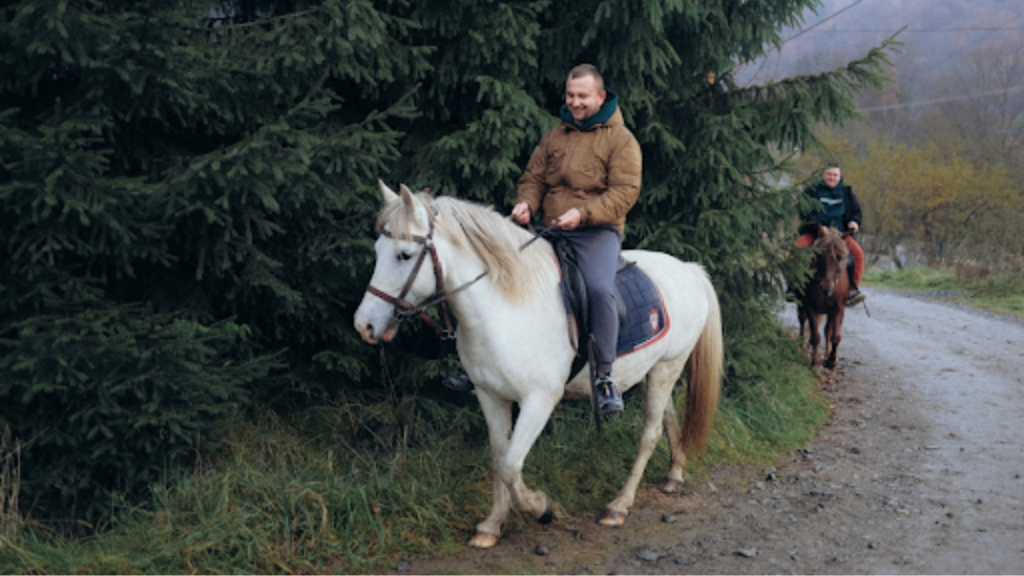
Sitting in a coach bus inching across the Ukrainian border, Ostap battled with the organizers of the journey he was on. Maryna Sadykova, who headed the retreat, recalled the young combat medic arguing with her as she sat on yet another bus filled with Ukrainian combat medics on their way to a remote retreat: Why waste money on a recovery retreat for frontline paramedics when drones were so desperately needed to win the war? Why not donate every spare dollar to purchase more weapons for the Ukrainian army?
A medic with the Azov brigade, Ostap had been ordered to go to the retreat by his commanding officer. He hadn’t wanted to leave the frontlines. But just days later — after swimming, painting and attending group therapy sessions with other medics – he turned to Sadykova and said he understood: Mental health is a weapon as well.
Around the same time, in the Ukrainian city of Kyiv, Oleksiy rested on the floor of the yoga studio, moving into his final resting posture a few minutes before his classmates. It had been only one week since he had surgery to prepare his residual left thigh for a new prosthetic and his body was tired. But he was still eager to attend the yoga class he’d been going to for the last five months, at a rehabilitation center for Ukrainian war veterans with complex amputations.
“I do everything that is available here,” says 26-year-old Oleksiy, referencing the programs available at the Tytanovi rehabilitation center. His favorite part of the yoga class: “The end when you lie down. Everyone loves that.” For veterans struggling to sleep at night, due to pain or PTSD, the chance to rest is invaluable.
Oleksiy, who, like Ostap, shared only his first name as is common practice among Ukrainian soldiers, attends class each week with teacher Viktoriya Lukyanenk and half a dozen other veterans.
“They have a problem with feeling themselves, their mind, soul and body,” Lukyanenk said, explaining that she helps veterans process how they feel after different movements and settle their nervous systems. “Yoga to them is to feel the connection with themselves again.”
These passages are from two new stories for MindSite News by freelance correspondent Cecilia Nowell, who last wrote for us about how an outdoor game called pétanque lifted the spirits of lonely, older Ukrainians in villages attacked by Russia. Click here to read her stories on the Kyiv yoga class for war amputees and forest retreats for combat medics.
The name “MindSite News” is used with the express permission of Mindsight Institute, an educational organization offering online learning and in-person workshops in the field of mental health and wellbeing. MindSite News and Mindsight Institute are separate, unaffiliated entities that are aligned in making science accessible and promoting mental health globally.

Author

Related Articles

Cornell Assault Prompts Parents to Talk With Their Sons
Sexual assault on campuses nationwide is still a grave problem.
The Unseen Toll: Depression, Anxiety Plague Black Women a Year After Being Fired by DOGE
When Trump cut DEI programs and allowed DOGE to gut the federal workforce, hundreds of thousands of Black women lost their jobs. Many are still reeling.
Exclusive: A Maternal Policy Expert Weighs in on Lindsay Clancy Mistrial
Policy expert Joy Burkhard discusses maternal mental health policy, postpartum psychosis misunderstandings, and new CA mental health parity laws.