
Parents Rethink How to Raise Boys Who Will Stand Up for Women
Parents can raise boys to respect consent, challenge peer pressure, and stand up against sexual assault and harmful masculinity.
Greetings, MindSite News readers.
In today’s Daily, the furor around the Cornell fraternity charges lead parents to rethink how to raise boys who will stop harm — not just avoid causing it. We look at how the Teen Center at a Manhattan library offers a sought-after “third space” for youth to socialize – and how Karen youth in Minnesota navigate two worlds and an opioid crisis. And a new Colorado law requires youth coaches to learn how concussions can affect young athletes’ mental health.
But first…MindSite News featured on MS Now
On Saturday, MS Now correspondent and host Antonia Hylton featured MindSite News reporting on her program The Assignment, broadcast live from the No Kings Day protest in New York City’s Washington Square Park. Here’s a screenshot from the broadcast:

Hylton focused on the FIRED series produced by MindSite News in collaboration with The Nation, Capital B and The 19th that examined the mental health impacts on Black women fired by Elon Musk and DOGE in the early months of 2025. Hylton did a live interview with Darlene Tart-Scott (seen below), a former federal employee featured in the series, which was written by Lottie Joiner.

Going beyond consent: Teaching boys to speak up
Horrific news of sexual assaults on college campuses continue to break across the country, from the case of the “Cornell 7” earlier this summer to allegations reported at the University of Chicago just this month. The situation is prompting parents to rethink how to raise their sons to end a culture that allows such violence to permeate. Understanding and respecting consent is only part of the conversation.
“I don’t want women’s safety to remain primarily women’s work…I want men teaching boys that being a good man requires more than simply not being the person who causes harm. Sometimes it requires being the person willing to stop it,” mother and survivor Tomika Anderson wrote in Essence. Parents can support boys in developing such courage by nurturing their emotional health and allowing them to express feelings beyond anger and aggression.
“For me, raising a boy differently has less to do with telling him what kind of man he should become and more to do with what we allow him to practice now,” Christopher Everett told Salon. He’s teaching his 4-year-old son that strength and gentleness are not opposites, adding “I want him to learn that another person’s boundaries matter even when he doesn’t understand or agree with them and that kindness isn’t something you perform only when adults are watching.”
Licensed marriage and family therapist Diana Chu sees the cost of losing that bravery in her work coaching male business executives, many of whom still fear breaking from the group when they want to be liked. “They learned early that staying in step with the group was safer than being right, and the cost of questioning values and ethics is high,” she told Salon. “The question parents are asking after Cornell is really how to raise a boy who will take the risk and leave the room.”
Addendum: Feminist writer and philosopher Kate Mann, who teaches at Cornell, has called for abolishing all fraternities. She recently interviewed her former student Diego, an ex-fraternity brother, in a eye-opening piece for the New York Times and on her Substack. In another recent piece regarding rape culture, she counsels a 17-year-old girl who contacted her and advises all young women in college to avoid contact with fraternities. – Diana Hembree
Remodeled 5th Avenue library in NYC offers a safe and welcoming space for teens to connect

In a new MindSite News feature, journalist Yesenia Ramos writes about a Teen Center that’s serving as a hub for kids under 18 in New York City:
As young people in Gen Z and Gen Alpha cope with mounting feelings of isolation, political division and over-dependence on screens, they’re also searching for “third places” – places outside of home and school – where they can connect and have social time free of the pressure in the rest of their lives. A recently remodeled branch of the New York Public Library offers a Teen Center where kids can learn music production and other skills, get help with job applications and spend time together in a safe space.
Formerly the Mid-Manhattan Library – the same library that referred a young Barack Obama to his first community organizing job – SNFL recently underwent a four-year renovation, supported partly by a $55 million gift by the Stavros Niarchos Foundation. As the flagship of the New York Public Library system serving the Bronx, Manhattan, and Staten Island, it offers the libraries’ largest Teen Center, welcoming teens ages 13 to 17.
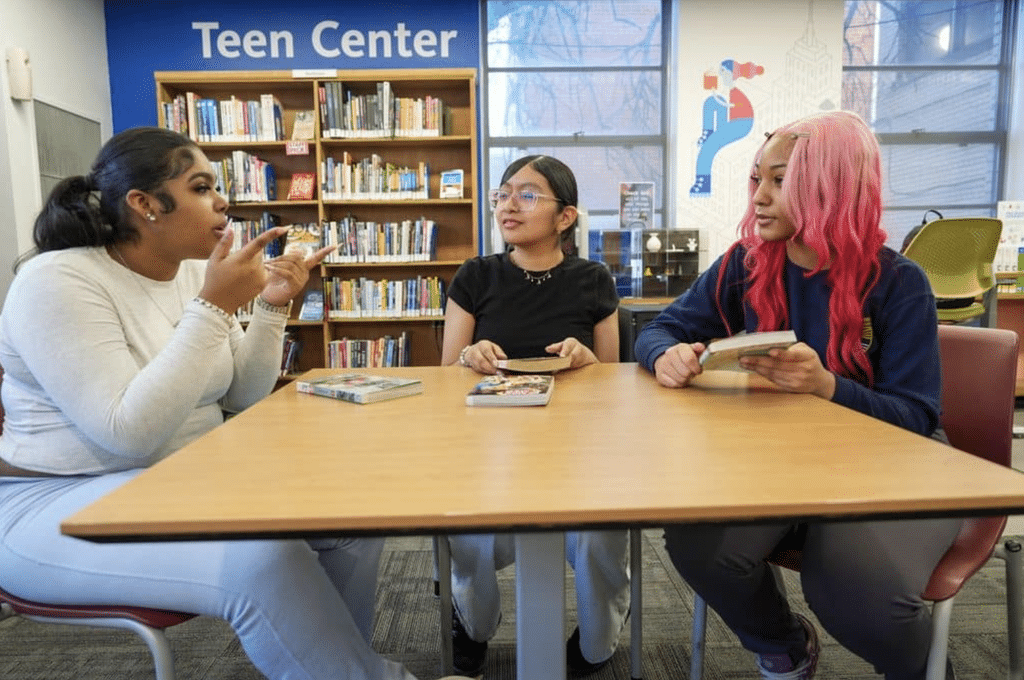
At a recent visit to the branch’s Teen Center – one of 23 teen centers among the 92 public libraries in New York City – Casper P., who was crocheting as she caught up with a fellow patron, says she has been coming to the Teen Center once a month every Friday. “It’s really nice, it’s very welcoming,” she recalls. “It’s so nice where you’re allowed to be yourself without it being high school, because high school sucks.”
One of the regulars is Yassin Khalifa, a rising senior at Brooklyn Tech, a public high school specializing in science, technology, engineering, and mathematics in New York City. He says he can’t remember what he did with his time prior to visiting the branch, only that he would often go home directly from school. At the library, Khalifa says, “I have people who support me, people who do care if I ever need to talk to someone.” Channeling his creativity into music at the Teen Center’s recording studio, he has produced so much music he has lost count. “I’m incredibly grateful for the people here and the resources that they provide,” he says. “The people here have changed my life for the better.” Read the whole story here.
‘I’m Sticking to My Sobriety’: Minnesota’s Karen Teens Navigate Two Cultures and an Opioid Crisis
For MindSite News and MinnPost, reporter Andy Steiner found that in St. Paul, community collaboration is the ‘secret sauce’ helping the fight against opioid addiction among at-risk refugee Karen and Karenni youth. The story opens as a nonprofit organizer meets a Karen youth who had struggled with opioid addiction:
It’s a warm Wednesday afternoon in September, and teens and their young-adult mentors are filing into The Urban Village, a St. Paul, Minnesota-based nonprofit that supports young people in the city’s Karen and Karenni refugee communities. Everyone is animated, greeting each other excitedly at this first weekly meeting of the new school year.
D*, a fashionably-dressed young man wearing loose, low-slung jeans and a bright shirt, steps into the light-filled space. He greets friends and sizes up the action before Carly Roepke, Urban Village’s director of operations, arrives at his side. She’s excited to see him, but plays it cool. She was worried that something bad had happened to him.
Life in the Twin Cities has opened up since Metro Surge, when many refugee families went into hiding and students moved to online school. The years before that had also been difficult ones for many Karen and Karenni families.
“I hadn’t seen him since before Metro Surge,” Roepke said later, referring to the months-long ICE immigration enforcement operation that took over the state in the winter of 2026. “Somehow he found his way back here.”
But the best news she received: D was clean and intended to stay that way. Read our story about the efforts made by Urban Village and other organizations working together to reduce rates of youth addiction in the community.
In other news…
Working at the intersection of art and social justice: Gary Tyler: Rebirth is on display now at the Grand Rapids Art Museum in Grand Rapids, Michigan. Tyler’s first solo exhibition is both a stunning creative expression and an act of witness for the life this nation withheld from him. Arrested in 1974 at age 16 for “mouthing off” to a white police officer during a wave of anti-school integration violence in Louisiana that left a 13-year-old white teenager dead, Tyler was later unjustly charged and convicted of murder and attempted murder and sentenced to death, NPR reports.
Though the Louisiana Board of Pardons and Committee on Parole recommended him for a pardon three times, it was never granted. Rather, after a 2016 Supreme Court ruling requiring all people sentenced to life without parole as juveniles to be resentenced, he accepted a manslaughter plea for a crime he says he did not commit – in order to leave prison at age 58. The fabric art on display in his show challenges viewers to recognize the humanity often forgotten among the incarcerated at the Louisiana State Penitentiary, also known as Angola, and to understand that Tyler’s story is one among many.
After a 13-year-old’s death, Colorado links concussions to mental health: After Alyssa Peterson died by suicide in 2019 at age 13, her mother, Stella Deslongchamp, found hospital records confirming that the young soccer player and ski racer had suffered multiple concussions. She wondered if they significantly impacted her daughter’s mental health. The family’s advocacy led to Alyssa’s Youth and Mental Health Protection Act, a Colorado law that took effect this past August, KUNC reports. It builds on the state’s Jake Snakenberg Youth Concussion Act, passed in 2011 to honor the 14-year-old football player who died in 2004 after repeated head injuries. That law already requires coaches to complete annual concussion training, pull athletes from play when a concussion is suspected and get a provider’s written clearance before they return.
Alyssa’s Act adds provisions for mental health, requiring coaches to complete training every two years covering anxiety, depression, trauma, substance use and suicide prevention. The law also obligates coaches to notify parents and urge a medical evaluation anytime an athlete is removed from play for a suspected concussion. The bill’s sponsors say that it is the first law in the country requiring coaches to learn how concussions increase the risk of mental health conditions later in life.
The name “MindSite News” is used with the express permission of Mindsight Institute, an educational organization offering online learning and in-person workshops in the field of mental health and wellbeing. MindSite News and Mindsight Institute are separate, unaffiliated entities that are aligned in making science accessible and promoting mental health globally.


Author

Related Articles

Youth Well-Being Has Plummeted Since Its Height in 2010
Fewer than half of Americans are thriving, with young adults suffering the most.
Star Athletes Open Up About Mental Health at Healthy Minds Festival
Athletes shape how Americans picture strength, which puts them in a unique position to show that male vulnerability belongs in that picture.
Nature Rx: A Prescription That May Save Your Life
A healthcare movement that “prescribes” time outdoors and in community to people struggling with their mental health.