
The Unseen Toll: Depression, Anxiety Plague Black Women a Year After Being Fired by DOGE
When Trump cut DEI programs and allowed DOGE to gut the federal workforce, hundreds of thousands of Black women lost their jobs. Many are still reeling.

Greetings, MindSite News readers.
In today’s Daily, we feature the first of a three-part series on the devastating impact of the DOGE layoffs on Black women, a collaboration between MindSite News, Capital B, The 19th News and The Nation. In other news, Portland Village, run by its unhoused residents, is outpacing city shelters on cost and housing outcomes. Plus, Chicago death doulas revive cemetery picnics, death cafes and our permission to grieve.

But first, I missed this a couple of years ago, but thought it remained relevant today. Tucked into a wooded stretch north of Grand Rapids, a cream-colored rotary phone is affixed to a maple tree. It’s one of at least 12 “wind phones” across Michigan and hundreds worldwide, where the grieving pick up the receiver to talk with loved ones who have died, Bridge Michigan reported. Tracey Mayeda installed the phone at the Howard Christiansen Nature Center to honor her parents, and she still dials her childhood phone number when she calls. “Hi Momma,” she says. “How are you doing?”
The tradition began in Japan, where Itaru Sasaki built the first wind phone while mourning his cousin, then opened it to thousands of families after the 2011 tsunami. “You feel you’re talking to their souls,” said 88-year-old Shirley Franchock, who used a wind phone at the Clinton Township Senior Center to speak to her late husband. “It’s unbelievable.”
The Unseen Toll: Depression, Anxiety Plague Black Women a Year After Being Fired by DOGE
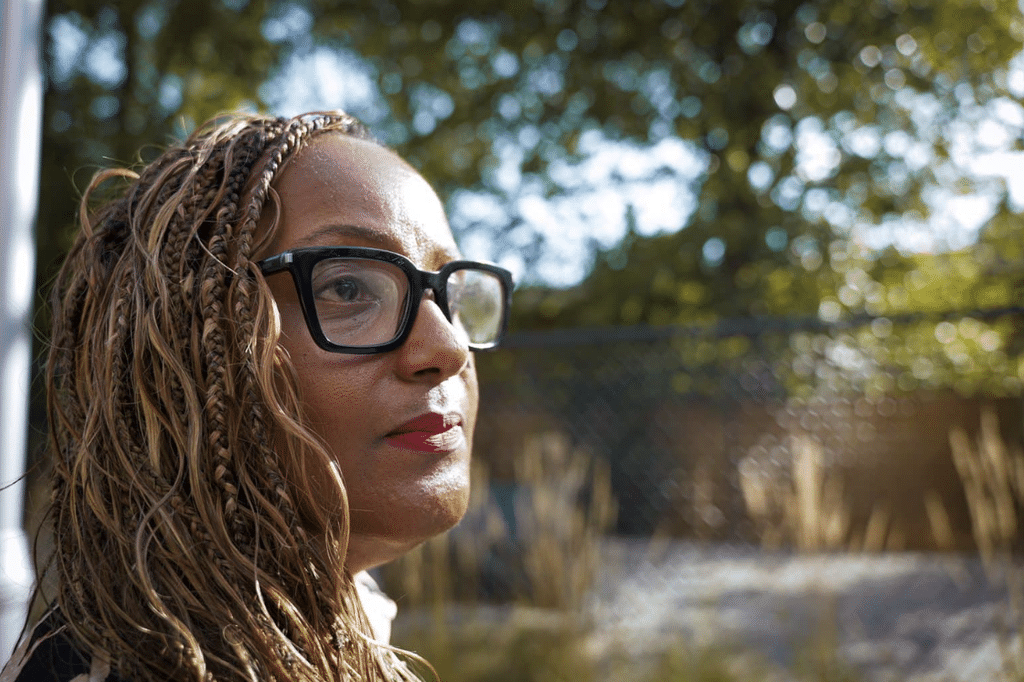
When Trump eliminated DEI programs and empowered Elon Musk and his Department of Government Efficiency (DOGE) to gut the federal workforce, thousands of Black women lost their jobs. The cuts dismantled an employment pipeline for Washington D.C.’s Black residents and gutted the well-being of the women who hold up that community.
Among those impacted was Darnese Foster, who remembers the day she was fired from her federal government job.
“I was off that Friday, which was Valentine’s Day. Then that Monday was the holiday,” said Foster. “I went to log in that Tuesday, I couldn’t get in,” she recounted.
Foster thought that her password had expired and needed to be reset and called the IT department. Later that day, an IT worker and her supervisor both called back to tell Foster that she was on a list of employees on probation that were being terminated during the mass firing.
Foster’s initial reaction was numbness, then panic and dread. She had a child in private school and rent and a car note to pay.
Now, more than a year after being fired from her position as a grant management specialist in the Department of Health and Human Services, Foster is struggling, not just financially, but psychologically. She has applied for more than 100 jobs without success and is braiding hair to pay for her daughter’s school. The constant strain, she says, has taken a toll on her mental health.
“When employment disappears suddenly, people aren’t just grieving that aspect of a paycheck, they’re grieving a future of a world that they could count on,” says Dr. Raquel Martin, a licensed clinical psychologist who specializes in Black mental health. And when demands exceed your resources, Martin adds, the stress can be almost unbearable.
“I thought I would have a job a year later,” said Foster, 47, who feels like she’s in a “sunken place.”
“I’ll drop my youngest off at school and just sit in the car and cry,” Foster said. “What’s next? Where am I going to get the money to keep a roof over our heads?”
Visit the series page and read the story here.
–Diana Hembree and Lottie Joiner
Portland’s self-run village for unhoused people costs less and houses more folks
Since a 2024 Supreme Court ruling stripped federal protections from people living on public property with nowhere else to go, sweeps of unhoused encampments have increased nationwide. But clearing a camp does not resolve the next destination of its residents. Dignity Village, in Portland, Oregon, offers an innovative solution: let them decide for themselves. “Welcome to our radical experiment in collective self-empowerment to end homelessness!” the village manual declares, according to the New York Times.
Founded in 2001, the village took shape after unhoused Portlanders, worn down by repeated encampment evictions, staged “shopping cart parades” that drew national attention. The protestors eventually settled on a plot of city-owned land next to a composting facility, where officials have reluctantly let them stay ever since. With help from volunteers, tents evolved into basic wooden structures or tiny homes with no running water that are now powered by donated rooftop solar panels. The self-governed community, which houses around 60 people, also boasts a guard shack, computer lab, bathhouse and greenhouse, which doubles as an emergency shelter. An obscure state law that designates the site an urban campground gives residents some flexibility on building codes.
To live in Dignity Village, residents must contribute 10 hours of work each week to community maintenance, limit drug and alcohol use to private spaces and agree to have disputes resolved by the village’s elected council. Rules on cleanliness, hoarding and fire safety are also enforced according to standards that the fire marshal and environmental regulators require. Beyond that, the community relies on peer pressure and care, not punishment, to keep the peace, expelling people only in extreme cases that usually involve violence.
That approach sets Dignity Village apart from the rule-heavy tiny home villages spreading across the country, which many unhoused people avoid in favor of the street. “Your peers hold you accountable if you’re slacking or engaging in negative behaviors, which hits a lot different than if a staff member of a traditional shelter nags you or gets you in trouble,” said Victory Lafara, a social worker who has long advocated for the community. “It means more and actually motivates people to make the changes they need to make.”
And compared to city-run shelters, sustaining Dignity Village is extremely affordable. Funded primarily by residents’ $100 monthly dues and resident-run businesses, including landscaping and firewood sales, the entire operation costs about $60,000 per year, or $1,000 per resident. Portland’s city-run tiny home villages, on the other hand, cost taxpayers an estimated $40,000 per person. Although city leaders are not fully sold on the model, some city council members are. “I am going to be looking for opportunities to take money away from the city’s shelter system and divert it towards enabling more of this,” said economist and Portland City Councilor Mitch Green, who also noted that spending on shelter programs was the “biggest driver” of the city’s recent $170 million budget shortfall.
Death doulas give Americans permission to grieve again
Sandi Bianchi was born to heal. Or rather, she was reborn to help guide others to their end after her own near-death experience at age 14. She made the choice to return, despite the love and understanding she felt beyond her body, because returning to earth would enable her to help other souls attend their “life graduation” without fear, she said. It’s even in her blood, she told the Chicago Reader, explaining that her maternal grandmother was a curandera, a healer who visited the dying in their homes in Casacuarán, Mexico and prepared their bodies for ceremonial rites. Today Bianchi is a death doula and cofounder of the Chicago Death Doula Collective, a volunteer network of more than 100 end-of-life workers. Through her practice, she has guided more than two dozen people at their end — sometimes climbing into bed beside them.
She has a knack for helping people engage critical discussions about end-of-life in our death-avoidant culture. One family invited Bianchi to work with their matriarch, who had dodged talks about her pending death, delaying decisions about important matters like her will, desires for organ donation and burial. Approaching the woman like a friend, as the family had introduced her, Bianchi helped organize a binder containing the matriarch’s birth certificate, will, life insurance policy and power of attorney, with copies for each of her children. “Now you can live your life, and you don’t have to worry about this,” Bianchi told her. “Go on a trip; go do things off your bucket list now.”
Those sorts of interactions are typical in the work of a death doula, as they help dying people move from a state of dread towards feeling ready. Interest in the field is expanding as demand for their services climbs. Membership in the National End-of-Life Doula Alliance grew from 250 in 2019 to more than 1,545 in 2024. Though about 10,000 doulas worldwide have received some training, the field remains unregulated, requiring no formal certification to practice.
Importantly, death doulas are not medical providers; pain management and symptom care remain the work of hospice and palliative teams. But they are a vital mental and practical support, helping fill emotional and logistical gaps families often face alone, like advocating for a dying person’s wishes, organizing home funerals and helping with non-legal paperwork – as well as lining up hospice early because it can take one or two weeks to set up. That way, the patients can have the comfort and pain-free care they need.
Part of the gap in the healthcare system is cultural, reporter Ali Hickerson writes. The Civil War sent Americans to die far from home, changing the way Americans encountered and managed death. Embalming also boomed after President Abraham Lincoln’s assassination when his body toured the nation, making it far more common for professionals rather than families to prepare human remains for burial. Then, during World War I, Woodrow Wilson’s administration dismissed public mourning as unpatriotic. Long-held customs like Victorian-era cemetery picnics faded with them.
Alejandro Salinas, cofounder of the Chicago Death Doula Collective with Bianchi, began hosting free “death cafes” after his father died of COVID. Many people, he said, have lost permission to grieve out loud. “I’ve had people tell me that whenever they try to bring up grief, someone says, ‘You should see a therapist about that,'” he said. “And it’s like, ‘No, I just want to connect with my friend about what I’m experiencing in my life.'” This summer, the collective also revived cemetery picnicking with monthly gatherings at Rosehill Cemetery.
In other news…
Turning up the heat on depression: Saunas are having a moment, from U.S. gyms to the floating sauna villages in Oslo’s harbor, and scientists are racing to find out whether the mental health benefits devotees swear by are real. Early evidence is intriguing. In one small trial, most people with depression who underwent a single whole-body heat session saw their symptoms cut in half within a week. Psychologist Ashley Mason, who has found that depressed people tend to “run hot,” believes heat may work like a “thermoregulatory workout,” training the body to cool itself more efficiently. Her pilot studies pairing heat with therapy left most participants in remission. Still, she told NPR, “we’re very much at the beginning of this research.”
The name “MindSite News” is used with the express permission of Mindsight Institute, an educational organization offering online learning and in-person workshops in the field of mental health and wellbeing. MindSite News and Mindsight Institute are separate, unaffiliated entities that are aligned in making science accessible and promoting mental health globally.


Author

Related Articles
Exclusive: A Maternal Policy Expert Weighs in on Lindsay Clancy Mistrial
Policy expert Joy Burkhard discusses maternal mental health policy, postpartum psychosis misunderstandings, and new CA mental health parity laws.

$1 Million to Help Heal Minnesota’s Cascade of Trauma
In today’s newsletter, NAMI Minnesota has launched a new grant-giving initiative to help agencies doing crucial work to support mental health.

Chicago Launches its First Psychiatric Street Team
Meet Chicago’s first Street Psychiatrist, a student of the street medicine pioneer Jim Withers. Plus, a look at the American Penal Press Contest.