
MIA at the debate: Discussion on mental health
Two of the most serious challenges facing America – mental health and the treatment of addiction – went MIA, or perhaps AMA (against medical advice) in last week’s presidential debate.


Monday, July 1, 2024
By Don Sapatkin

Good Monday morning! Mental Health PAC – billed as the first political action committee formed specifically “to protect and elect high-impact state and federal candidates who make it their mission to improve access to mental health care in America” – launched recently with a D.C. fundraiser. It’s about time!

In today’s Daily: Two of the most serious challenges facing America – mental health and the treatment of addiction – went MIA, or perhaps AMA (against medical advice) in last week’s presidential debate. There were plenty of opportunities to address them. But neither President Biden nor former President Trump made any attempt to acknowledge the pain they are causing hundreds of millions of families, to discuss their plans to combat these problems or, in Biden’s case, to talk about the record levels of funding his administration has invested in mental health over the last four years.
Here is what Trump and Biden could have said:
Mental health
The CNN moderators did not ask either candidate how they would address the mental health crisis that is particularly affecting young people. But they could have brought up their plans in response to any number of questions. In fact, Trump did use the word “mental” three times, according to CNN’s transcript, all of them accusing Biden of opening up the border to undocumented immigrants from mental institutions – a statement that is blatantly false and stigmatizes people with mental health issues, as well as immigrants.
Biden made no attempt to push back. He could have taken the opportunity to tout his record on mental health or discuss his surgeon general’s declaration two days before that firearms violence is a public health crisis. Surgeon General Vivek Murthy, who served under former President Obama, was fired by Trump and reappointed by Biden, has pursued a broad mental health agenda, issuing earlier advisories on youth mental health, loneliness, and social media’s impact on youth mental health, followed by his call two weeks ago for warning labels on social media platforms.
The latest Surgeon General’s Advisory, “Firearm Violence: A Public Health Crisis in America,” focuses on suicides as well as the outsize impact of gun violence on youth mental health. The nation’s firearms suicide rate increased more than 20% between 2012 and 2022 and, while the numbers are quite small, by nearly 70% among children ages 10 to 14. Fears and worries about gun violence, especially school shootings, are high among youth. Students exposed to school shootings experience “declines in health and well‑being, engage in more risky behaviors, and have worse education and labor market outcomes as young adults,” according to one recent study quoted in the report. Another found that local exposure to fatal school shootings is associated with a 21% increase in youth antidepressant use in the following two years.
Mass shootings account for only 1% of firearms deaths, but the highly publicized tragedies play a much bigger role in how Americans are feeling. A “deep sense of fear” pervades American society, Murthy told Politico. “We think about where many of these mass shootings are taking place – in schools, at parades, at concerts, in houses of worship – these are part of the fundamental components of our day-to-day life.” His report argues for measures that put more space between firearms and people at risk of hurting themselves or those around them. That includes laws intended to prevent children from accessing guns, mandatory universal background checks for firearm transactions, including those given as gifts, and a ban on civilian use of assault weapons.
Banning cell phones in schools
Both Trump and Biden could have discussed New York City’s coming ban on cell phones in public schools as part of a debate about how the government can protect children from the harmful effects of social media, especially the way most kids use it – on their phones. Surgeon General Murthy’s call last month for Congress to require warning labels on social media platforms is part of the same discussion. The prohibition on cell phones in classrooms by the nation’s largest school district, expected to take effect sometime in the 2024-25 school year, follows by one week a decision by the second-largest district, Los Angeles Unified, to do the same starting in January. Florida and Indiana have taken similar steps.
Students’ mental well-being is a major concern, as are the constant distractions that can get in the way of learning. Researchers disagree about the degree of culpability that cell phone and social media use play in the youth mental health crisis but almost no one doubts their contribution. “Across the world, kids have become fully addicted to these phones,” New York City Schools Chancellor David Banks said in an interview with Education Week. He is expected to release details of his plan this week.
Treatment of addiction
The moderators did bring up the opioid crisis. “Former President Trump, … more than 100,000 Americans are dying from overdoses every year, primarily from fentanyl and other opioids,” said CNN moderator Jake Tapper. “What will you do to help Americans right now in the throes of addiction, who are struggling to get the treatment they need?”
Trump responded by talking about the deficit and his tariffs on China.
Tapper: “President Trump, you have 67 seconds left. The question was, what are you going to do to help Americans in the throes of addiction right now who are struggling to get the treatment they need?”
Trump talked about enforcement and how “the number of drugs coming across our border now is the largest we’ve ever had by far.”
Tapper: “President Trump, thank you. President Biden?”
Biden talked about a bipartisan deal that would have substantially increased border security, but which Trump pressured congressional Republicans to kill.
Tapper: “Again, the question is about Americans in the throes of addiction right now struggling to get the treatment they need.”
Neither candidate discussed any strategy to help Americans struggling with addiction.
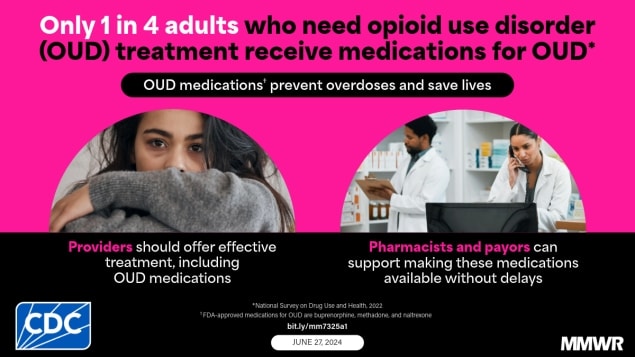
Shortly before before the debate, the CDC published an analysis that found that in 2022, only 25% of people needing treatment for opioid use disorder (OUD) received medications that have been shown to be the most effective form of treatment and to reduce fatal overdoses.
Another 30% received treatment, but without the medications. Among the reasons cited for their lack of use: Most pharmacies don’t stock the most popular medication, buprenorphine. Many payers, including state Medicaid programs, set up hoops that can delay buprenorphine dispensing. And methadone, the other treatment mainstay, is allowed to be dispensed only by federally certified centers.
The report recommended “expanded communication” about the effectiveness of these medications for opioid addiction and urged clinicians and other treatment providers to offer them. “Pharmacists and payors can support making these medications available without delays,” it said.
Biden and Trump could have discussed what they would do in their next term to increase availability of these lifesaving medications.
Supreme Court ruling on the opioid settlement
On the morning of the debate, the Supreme Court blocked a landmark opioid settlement that would have protected the Sackler family’s fortune in exchange for billions of dollars to fund addiction treatment and prevention campaigns and to compensate states for what they spent dealing with the opioid crisis. (Washington Post coverage here.) Now those funds will be delayed. The 5-4 decision, which scrambled ideological lines, concluded that the U.S. bankruptcy code does not allow a court to shield the Sackler family, which owns Purdue Pharma, from future lawsuits. Purdue declared bankruptcy in 2019, as it faced thousands of lawsuits and allegations that it kick-started the crisis by the aggressive marketing of its blockbuster painkiller OxyContin. The company had agreed to pay up to $6 billion over 18 years as part of the bankruptcy plan. But family members did not file for bankruptcy themselves.
The plan was controversial: As information came out about how some family members pushed the company to continue down a path that they knew would kill thousands of patients, the Sacklers became perhaps the most reviled family in America today. The high-stakes legal fight has divided relatives of overdose victims and those whose lives were destroyed by opioid addiction. Some said the bankruptcy deal allowed the Sacklers to get off easy, while others insisted that immunity was the only way to get badly needed money to communities and victims. As a result of the ruling, states and other parties suing Purdue will have to restart complex negotiations, likely putting off compensation for years. It could also affect major settlements in other cases approved through bankruptcy courts.
Trump and Biden could have said something about this issue as well. But at least we know something about their golf handicaps.
In other news…
“Sometimes, Forgiveness Is Overrated,” according to a thoughtful discussion in the New York Times about when forgiveness helps (usually), when it doesn’t (if you’re pressured to say it), and under what circumstances. Forgiveness, even if it’s undeserved, can foster “qualities of compassion, generosity and even love” toward the person who wronged you, said scholar Robert Enright. But “imagine saying that to a trauma survivor,” Amanda Gregory, a trauma therapist in Chicago, told the Times. “That’s a tough sell.”
Pairing veterans with PTSD with a trained psychiatric service dog was associated with significant reductions in PTSD symptom severity, lower anxiety, and lower depression after three months compared with a control group who remained on the waiting list for service dogs, according to the findings of a non-randomized (but controlled and blinded) study with 156 participants. Both groups had unrestricted access to usual care. “Psychiatric service dogs may be an effective complementary intervention for military service–related PTSD,” the authors concluded in JAMA Network Open.
Dogs must be in the air: My colleague Diana Hembree’s recent eulogy to her beloved 8-year-old poodle-terrier Jefferson brought tears to my eyes. And the New York Times just published a fascinating special section: “Pets: How science went to the dogs (and cats).”
People who are highly resilient in the face of stressful events have distinct biological signatures in their gut microbiomes, NPR reported. Increasing research into the gut microbiome — the ecosystem of bacteria and other microbes that live in our digestive systems − has shown that it plays a significant role in communication between the gut and the brain. Changes in the microbiome are linked to mood and mental health. Previous research has found that patients with various psychiatric conditions have more gut bacteria that boosts inflammation and less that is anti-inflammatory. The latest study, in Nature Mental Health, suggested that people who are more resilient to stress had patterns of activity in their microbiomes associated with reduced inflammation.
A movement to decriminalize suicide in four Caribbean nations is gaining steam as a diverse coalition has formed for the first time to press for the repeal of draconian colonial-era laws, The Guardian reported. Mental health stigma is particularly high in the Caribbean, where there are barriers for people to access mental health services and for organizations to offer them. Suicide is illegal in St. Lucia, Grenada, the Bahamas, and Trinidad and Tobago. Attempted suicide is punishable by up to two years in prison or a fine. Although rarely enforced, some arrests have been reported. The laws were introduced by the British during colonial rule, but suicide was decriminalized in England, Wales and Northern Ireland in the 1960s. It was never a crime under Scottish law.
If you or someone you know is in crisis or experiencing suicidal thoughts, call or text 988 to reach the 988 Suicide & Crisis Lifeline and connect in English or Spanish. If you’re a veteran press 1. If you’re deaf or hard of hearing dial 711, then 988. Services are free and available 24/7.
Recent MindSite News Stories
Tasers Can Kill. When They Don’t, They Can Still Do Lasting Damage

Our investigation with Medilll documented widespread use of tasers in response to 911 mental health calls.
When a Pet Dies

Friends and family may not understand the depth of the grief you feel over the loss of a beloved pet. Here are some ways to cope.
A County Jail Near a Colorado Resort Town Uses Suicide Smocks and ‘WRAPs’ to Restrain Agitated Prisoners

Restraints are often used by law enforcement on people in a mental health crisis, but advocates say there are better approaches.
If you’re not subscribed to MindSite News Daily, click here to sign up.
Support our mission to report on the workings and failings of the
mental health system in America and create a sense of national urgency to transform it.
For more frequent updates, follow us on Facebook, Twitter and Instagram:

The name “MindSite News” is used with the express permission of Mindsight Institute, an educational organization offering online learning and in-person workshops in the field of mental health and wellbeing. MindSite News and Mindsight Institute are separate, unaffiliated entities that are aligned in making science accessible and promoting mental health globally.
Copyright © 2021 MindSite News, All rights reserved.
You are receiving this email because you signed up at our website. Thank you for reading MindSite News.
mindsitenews.org

The name “MindSite News” is used with the express permission of Mindsight Institute, an educational organization offering online learning and in-person workshops in the field of mental health and wellbeing. MindSite News and Mindsight Institute are separate, unaffiliated entities that are aligned in making science accessible and promoting mental health globally.


Author

Related Articles

When a Child Is the Only Caregiver
Over 5.4 million child caregivers in the U.S. face rising rates of anxiety and depression in the face of proposed Medicaid cuts.
LA County’s Homeless Shelter System Is a Revolving Door
A new report reveals the LA homeless shelter system is failing to meet its targets, with nearly 60% of residents returning to the streets.