Therapists Grapple with Post-Election Despair
Tuesday’s election shook many therapists while also fueling demand for their services.


Tuesday, November 12, 2024
By Courtney Wise

Greetings MindSite News Readers. In today’s Daily, a look at how Tuesday’s election impacted therapists and the demand for mental health and crisis services. Doctors in Israel are studying hyperbaric oxygen therapy to treat PTSD in civilians who survived last year’s attack by Hamas.
Plus, some ideas on holding onto joy at a challenging time, embracing winter to push back against the seasonal blues, and the service dogs that are helping military veterans cope with the aftermath of trauma and injuries.
Therapists try to navigate their own emotions amid liberals’ post-election angst and surging demand
The results of last week’s election had an immediate impact on the mental health of millions of Americans – and their therapists. Contacts to the Crisis Text Line jumped by one-third on Tuesday, and calls, texts, and chat messages to the Trevor Project, a suicide prevention service for LGBTQ+ youth, jumped 125% according to the Washington Post. Mental health provider Spring Health had a 240% jump in bookings in the final two days before the election. And, on the morning after the election, mental health bookings on ZocDoc climbed 22% from 6 am to 8 am alone.
“I was more or less crying while my client was crying,” Danielle, an upstate New York therapist (who was identified only by her first name), told Fortune. She started Wednesday off thinking, “I don’t know how I’m going to do this,” and considered taking a vacation day. “But then I was like, ‘I can’t take the day off. I’m a therapist.’”
Many therapists are slammed with stress as they navigate their patients’ needs alongside their own worries of how their personal and professional lives will be affected by a second Trump administration. “I am uncertain how to handle themes of angst and existential dread,” clinical psychologist Sarah Darghouth wrote in STAT News. “Some patients bring up the end of democracy as we know it, mass deportations, and the threat of nuclear war. I would likely have questioned these scenarios a few years ago…Today, these thoughts don’t seem all that far-fetched.” She is especially worried about patients from vulnerable communities including LGBTQ+ people, immigrants and undocumented migrants. “I think it is likely many of us will not be OK,” she wrote.
Experts say it’s important not to give up and lose hope. If your anxiety and other emotions remain high, lean into your community and focus on the parts of your life that you can control. Of primary importance is the health of your mind and body. Unclench your jaw. Stop holding your breath. Consider meditation! Here’s a lovely (and free!) 14-minute guided meditation that can help keep you grounded.
Do your best to avoid isolation. Volunteering to support the causes that are important to you is one way to build community and take action. If you’re really feeling emotionally weighed down, spend some time around people seeking joy. Eventbrite and Facebook Events often feature free or low-cost gatherings for people sharing similar interests. And the outdoors is always available. Going for a walk to notice the leaves, ground, sky, and beauty can offer a mighty mood boost.
Hyperbaric oxygen therapy shows promise for treating PTSD
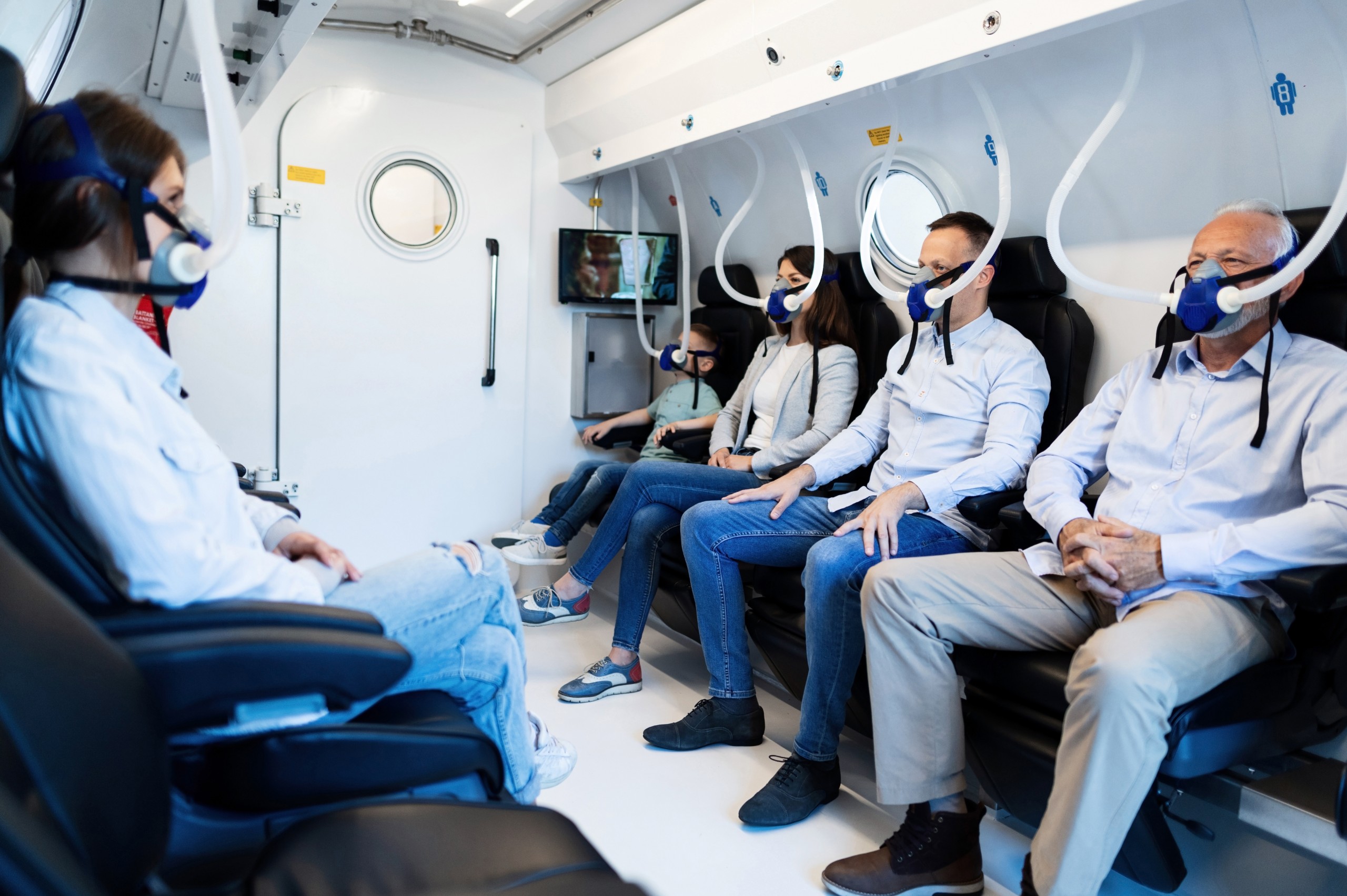
Hyperbaric oxygen therapy (HBOT) has long been used to treat compression sickness in divers and enhance healing in chronic wounds. Lately, it’s also being lauded as a promising treatment for post-traumatic stress disorder (PTSD) – at least in Israel. Shai Efrati, of the Sagol Center for Hyperbaric Medicine and Research, is using it to treat survivors of last year’s attack by Hamas. “What we are doing is actually tricking the body,” Efrati told CBS News. “Hypoxia, lack of oxygen, is the most powerful trigger to induce all the repair mechanism cascade.”
Efrati went on to explain how the treatment works. Patients sit in a chamber, in which the body feels like it’s 30 feet underwater. They then inhale pure oxygen, which under the highly pressurized conditions, is absorbed much faster by the body. Masks are then removed for five minutes to stimulate the body’s repair response. The decline from very high levels of oxygen to normal levels causes the body to generate new neurons and new blood vessels in the brain, Efrati said.
Shachar Mizrahi, an Israeli veteran, said he viewed HBOT as his last hope before suicide. “It’s the first time that I was feeling again. I begin to sleep at night, I was less afraid. It’s make me feel alive again,” Mizrahi said. “I was a dying man, and after this, I’m a living man.” After 60 HBOT sessions between June 2018 and March 2019, images of Mizrahi’s brain show increased activity in regions that regulate emotion and process information. Researchers at the Sagol Center also point to recent studies, one published just this week, that show significant improvement in PTSD symptoms.
Physician and North Carolina Republican Congressman Greg Murphy wants to see the treatment become available to veterans in the U.S., and expressed frustration that the Department of Veterans Affairs has not yet made it happen. “Look at the results in the last 15 years,” Murphy said. “Look at the studies in Israel. We are seeing an absolute effect in this, and other disorders, for Parkinson’s, migraines, some even MS, neurological disorders.”
Lin Weaver, a physician who runs the Department of Hyperbaric Medicine at Intermountain Health in Salt Lake City, said he has successfully treated a few PTSD patients with HBOT but with a price tag of $50,000 for a course of treatment, there aren’t enough studies to convince U.S. insurers to pay for it. Those companies will require more proof, and that means large-scale trials of HBOT for PTSD in the U.S. “What’s necessary is like a drug trial. But these trials take years to accomplish,” Weaver said. So far, his applications for funding to conduct such studies have been turned down.
In other news…
Holding onto hope in the midst of grief: Licensed social worker and disability activist Vilissa Thompson has some words of encouragement, in an essay published by Yes! Magazine. “Hope and joy are our birthrights as humans to hold onto and find when we need them, and they are essential elements when organizing for the world we desire to live in. Use history as a guide. Even amid the most unimaginable circumstances, people still found ways to push forward, build community, and fight for a more just world. If we don’t believe things can and should be better, then what will motivate us to not back down when beaten down (literally or metaphorically)?”
K9s for Warriors: Master Sergeant David Crenshaw couldn’t have imagined how much his dog, Doc, would change his life over the past six years. He and Doc were paired together with the help of K9s for Warriors, the nation’s largest provider of service dogs for veterans with PTSD, traumatic brain injury, or military sexual trauma. “I had always been taught how to win things, and not lose, and Doc was a major part of helping me gain my independence back with dignity,” Crenshaw told Good Morning America. “I was suffering from night terrors, insomnia, isolation, hypervigilance, and he just allowed for me to reintegrate with people — my family, society — and has given me a purpose beyond what I initially intended.” Lawmakers hope to continue to pair eligible veterans with certified service dogs through a bipartisan bill recently introduced in Congress. The Service Dogs Assisting Veterans Act, or SAVES Act, would supply funds to organizations like K9s for Warriors to amplify their work.
Reframe winter to reduce those seasonal blues: Winter is tough for a lot of us – and reframing how we think about the season can make living through it more joyful. Looking to nature – which is actually booming with action at a seemingly barren time – can do your mood some good. Holli-Anne Passmore, a psychologist who studies how to boost wellbeing in the winter months, told the New York Times that people who pay attention to their natural surroundings report feeling better. “I felt awe that such a tiny bird can withstand the cold,” wrote one subject. “I love trees, especially big ones. I feel humbled by their size, knowing just how much more lies beneath the surface, too,” wrote another. You can also embrace winter hobbies, just like you might in the summer. Create a “relaxing winter playlist” to set the mood while you learn to knit or take up painting. Gardeners, try tending to some indoor plants. And runners, hikers, and bikers know there are cold-weather trails that will welcome them all four seasons.
If you or someone you know is in crisis or experiencing suicidal thoughts, call or text 988 to reach the 988 Suicide & Crisis Lifeline and connect in English or Spanish. If you’re a veteran press 1. If you’re deaf or hard of hearing dial 711, then 988. Services are free and available 24/7.
Recent MindSite News Stories
‘The Fear Cut Through My Family’: Alarm Over Trump’s Potential Return Sparks Deep Anxiety Among Chicago Immigrants

As Election Day nears, immigrant-led coalitions provide support amid fears of mass deportations and violence.
He attempted suicide. Peoria Jail restrained him in a chair for five days.
Peoria County Jail in Illinois has kept mentally ill charges in restraint chairs far past industry recommendations.
If you’re not subscribed to MindSite News Daily, click here to sign up.
Support our mission to report on the workings and failings of the
mental health system in America and create a sense of national urgency to transform it.
For more frequent updates, follow us on Facebook, Twitter and Instagram:

The name “MindSite News” is used with the express permission of Mindsight Institute, an educational organization offering online learning and in-person workshops in the field of mental health and wellbeing. MindSite News and Mindsight Institute are separate, unaffiliated entities that are aligned in making science accessible and promoting mental health globally.
Copyright © 2021 MindSite News, All rights reserved.
You are receiving this email because you signed up at our website. Thank you for reading MindSite News.
mindsitenews.org
The name “MindSite News” is used with the express permission of Mindsight Institute, an educational organization offering online learning and in-person workshops in the field of mental health and wellbeing. MindSite News and Mindsight Institute are separate, unaffiliated entities that are aligned in making science accessible and promoting mental health globally.


Author

Related Articles

The Lindsey Clancy Murder Trial
Women nationwide watch the Lindsay Clancy trial and see themselves in her story, plus an investigation into hospitals that fail patients with addiction.
Grief and Rehabilitation in a California Prison
This month: a DUI offender’s path to rehabilitation, Lindsay Clancy revisited, Illinois prison protests, a fatal cell fire, and Missouri’s competency crisis.

Meta Pays $17 Billion Settlement for Lawsuit Over Child Harm
Meta will pay up to $17.1 billion and reshape how its platforms operate after 47 states argued that they are harmful and also addictive to children by design.