
Grief and Rehabilitation in a California Prison
This month: a DUI offender’s path to rehabilitation, Lindsay Clancy revisited, Illinois prison protests, a fatal cell fire, and Missouri’s competency crisis.

Welcome Back MindSiters,
This month, we head to a rally about the living conditions in prisons across Illinois. We revisit a timely interview on postpartum psychosis and race as the Lindsay Clancy jury continues to deliberate. We also take a look at how Missouri is failing to help defendants with serious mental health issues regain the mental capacity they need to stand trial.
But first, we’ll hear the story of one woman’s path to rehabilitation in a California prison after causing a fatal crash.
Let’s get into it…
A Woman Works to Rebuild her Life After Taking the Lives of Others in a DUI
Grace Coleman woke up in a hospital bed, groggy, confused, in pain and sedated. Her left arm was in a sling. Her right arm was handcuffed to the bed. Something was very wrong, but she didn’t know just what.
A nurse knew only a few details about the fatal crash that left two parents dead and three young daughters as survivors. An officer sat silently as the nurse delivered the news – that she had been the driver that hit them.
“I didn’t know what happened, who I killed, how I even got into my car that night,” Coleman said. “Because the last thing I remembered, I was nowhere near my car — so I had a lot of questions.”
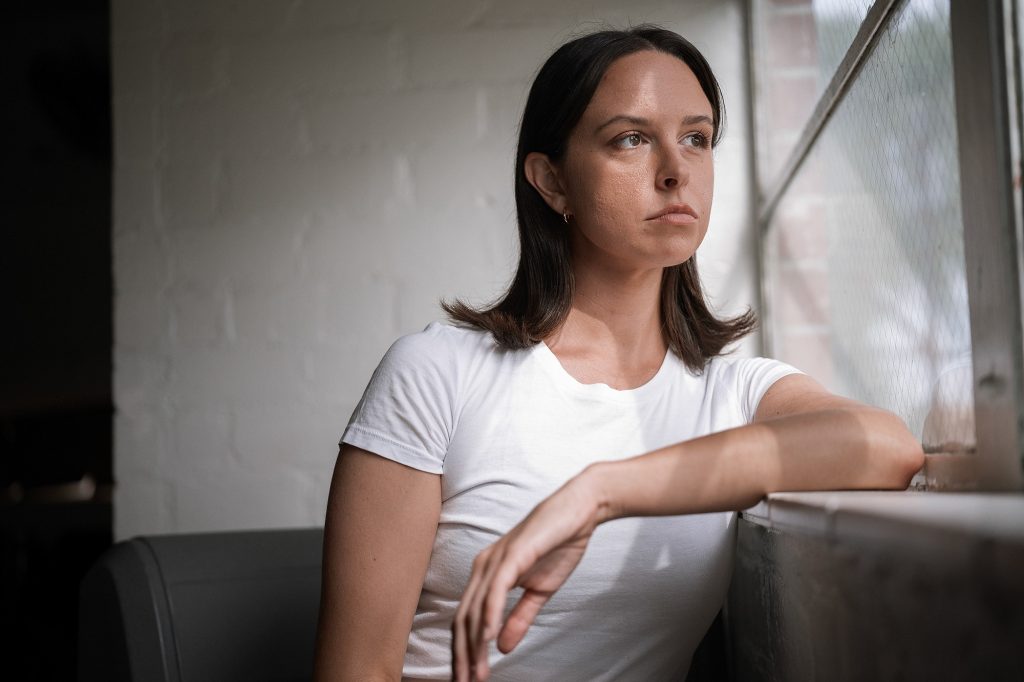
Today, Coleman is engaged in the process of trying to change herself – and make amends for her actions. But on Dec. 8, 2020, she was in a very different place.
That evening, Coleman’s boyfriend dropped her off at home in a blackout state after a day fueled by alcohol, drugs and their toxic relationship. Instead of entering her home in Newport Beach, California, she climbed into her Range Rover and drove off.
Minutes later, she crashed into a car carrying a family of five — killing Gabriela Andrade and Henry Saldana-Mejia.
DUI homicides leave survivors and communities looking for answers. They can also leave the offender struggling to reconcile what they did with who they are, as CalMatters reported in a recent story.
More than 1,300 alcohol-related driving deaths occur each year in California, though it is hard to say just how many people are prosecuted and convicted for causing the fatalities. Since Coleman learned of what she did that terrible night, she has been on “a path into recovery, rehabilitation and mental wellness,” according to CalMatters.

“It’s not even just as simple as, oh, I wake up in prison every day and that in itself is a reminder of the harm that I’ve caused,” she told reporter Joe Garcia. “It’s the way that I choose to live my life. It’s being in AA. It’s being a part of these DUI programs. Sharing my story in those spaces, that’s what keeps me sober.”
Coleman co-facilitates Responsibly Driven, a self-help curriculum specifically designed to help DUI offenders analyze their flawed decision-making patterns and learn to overcome them. Photo by Brian L. Frank for CalMatters/CatchLight
While awaiting trial in Orange County Jail, Coleman met with surviving relatives of the family — a rare opportunity for an offender, even rarer for someone who hasn’t been convicted. Coleman listened to their pain, felt anguish over their loss and tried hard to answer their questions through her tears.
Soon after that meeting, she pleaded guilty to two counts of murder and accepted a 21 years-to-life in prison sentence.
“For me, it definitely started with that day,” she said. “Any bit of denial that I was stuck in was gone. Any bit of selfishness that I still had — and caring about myself and what was going to happen to me — didn’t seem to matter as much anymore.”
To read the full story of her path to rehabilitation – and the surprising opinions of the attorney for the children whose parents she killed – click here.
Before Lindsay Clancy, There was Latarsha Sanders

After 18 hours of deliberation, jurors are deadlocked on their decision to convict or not convict Lindsay Clancy — the Massachusetts mother facing murder charges for the strangulation death of her three children.
The trial, which spanned more than four weeks, has become a national flashpoint on postpartum psychosis, criminal responsibility and what juries owe defendants who are mentally ill.
Boston Globe columnist Yvonne Abraham has been covering the trial closely, arguing it has effectively put two defendants on the docket: Clancy and “our broken mental health system.” She’s also written about the near-impossible pressure on jurors given the media circus around the case.
Those are the same questions Abraham spent seven chapters unpacking in her 2025 series on Latarsha Sanders — a Brockton mother convicted of killing her two sons in strikingly similar circumstances, but never received anything like the public sympathy Clancy has.
We interviewed Abraham about that series and what it revealed: Juries convicted the defendants in insanity-defense cases 36 out of 41 times since 1990, and race and class shape which mothers get treated as sick versus evil.
Revisit our interview with Abraham here.
The Prison on Fire

Illinois activists are continuing to wage their campaign against the proposed construction of a $900 million prison complex. On Thursday morning, members of No New Prisons Illinois gathered in downtown Chicago to demand that the state invest in community-based, non-carceral solutions to crime.
In the building behind them, the Illinois Capital Development Board hosted an informational meeting for design firms interested in building two new prisons in Crest Hill, Illinois, which the state is touting as modern and progressive — and focused on rehabilitation, education and recreation, as well as improved medical and mental health care. They are intended to replace aging facilities, including Logan Correctional Center, the largest women’s prison in Illinois.
“We know that a new prison won’t bring our loved ones home. We know that a new prison will not keep them safe. A new prison will only cause more harm and more violence,” Jane Mize said at the rally.
One by one, activists walked up to the microphone and pointed to recent reporting on ongoing and systemic failures in the Illinois Department of Corrections (IDOC) to illustrate that the money could be better spent in the community.
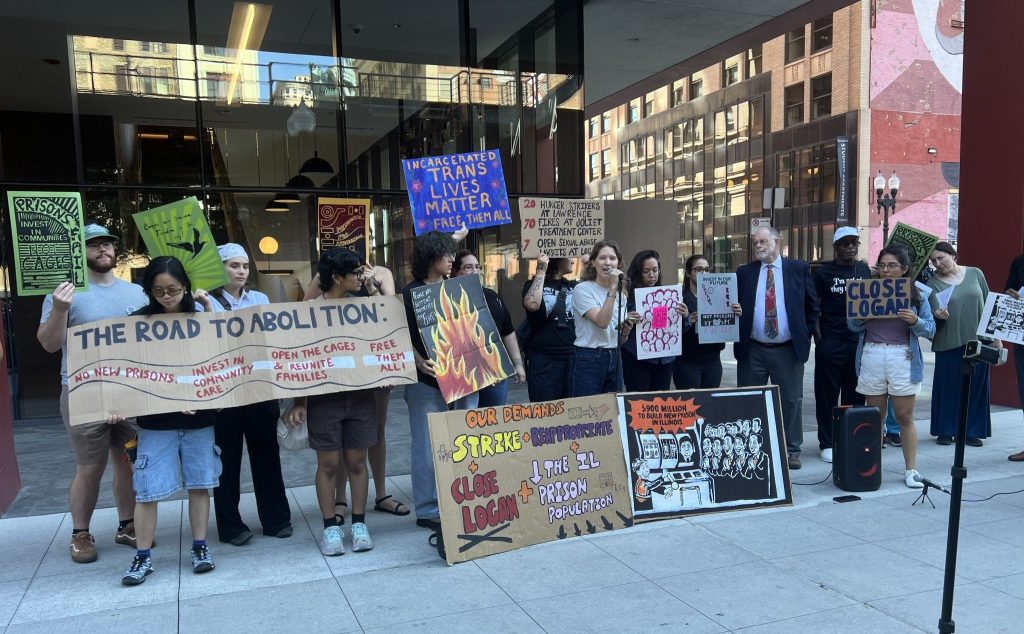
In July, we heard from women who had served time at Logan Correctional Center about the poor conditions they experienced there. Since then, horror stories have leaked from other state institutions.
“People incarcerated at Logan prison are facing abuse from staff and suffering from infestations and dilapidated conditions. People incarcerated at Joliet Treatment Center are setting themselves on fire to bring attention to the lack of mental health care. People at Lawrence Prison are on hunger strike over inhumane conditions,” Mize said.
The problems at Logan are well-documented: a lack of heat and hot water; too little food; mold that detainees have said affects their breathing; undrinkable water and limitations on how much water can be bought from commissary; rodents and pests inside the facility; rashes and other health problems linked to the dirty, dilapidated buildings, which have more than $100 million in deferred maintenance.
“I’m pregnant and eat all my food and still feel starving,” one woman responded in a survey. She also reported that bed mites bit her and other detainees and made their skin swell up.
Recent press accounts have highlighted poor conditions at Joliet Treatment Center, which opened in 2017 to treat detainees with severe mental illness. Although it opened with the promise of being a new kind of prison that would provide needed care, men detained there say conditions have declined, along with their mental health.
Over the last three years, more than 70 fires have raged at the facility, including a dozen cases in which incarcerated men set themselves on fire, as reported by The Marshall Project, WBEZ and the Chicago Sun-Times.
One man needed surgery to graft new skin onto his charred calf. Another lost a leg. Two have died: Jason Stephens and Martinez Duncan.
Last year, the prison — which has a population of about 200 people — recorded roughly three fires a month.
“These are the kinds of desperate acts that somebody takes when they feel they have no alternative,” Craig Haney, a professor at the University of California, Santa Cruz, told the Marshall Project.
On the night of July 27, 2024, thick, gray smoke escaped cell A9 at the Joliet prison and drifted down the hallway. Soon, the smoke became so thick you couldn’t see more than a few feet. Jason Stephens was locked in that cell.
When officers finally responded, they sprayed a fire extinguisher and then pepper spray through the food slot in the door. Then, they walked away.
Soon, firefighters arrived. They were told by guards that the fire was out but they needed help clearing the smoke. More time passed before the firefighters were told that someone was still inside the burning cell.

Jason Stephens died after starting a fire in his cell at the Joliet Treatment Center in July 2024. Courtesy of Jason Stephens’ family.
“They left him sitting in a smoke-filled cell,” said Alan Mills, a civil rights attorney who is representing Stephens’ surviving family. “Instead of getting him out, they pepper-sprayed him.”
When firefighters entered, they found Stephens lying on the floor, unconscious but still breathing. Guards handcuffed his unconscious body, and Stephens was loaded into an ambulance – but guards refused to open the prison gates until employees had filled out paperwork. .
“This man can die while y’all pussyfooting around,” a firefighter told one of the guards, according to the Marshall Project.
Two weeks later, Stephens, 38, died of ”complications of inhalational injuries” due to mattress fire.”
Mills was instrumental in the federal court settlement, Rasho v. Jeffreys, which required IDOC to overhaul psychiatric care for the estimated 12,000 incarcerated people with serious mental illness. He points to the failures to complete changes at Joliet Treatment Center and other facilities as a strong rationale for not building the new prison.
“Buildings don’t solve the problems. IDOC has a broken culture; it needs to be fixed,” Mills said at the rally. “$900 million could be spent way better in the communities, keeping people out of prisons..”
Read the full Marshall Project story on Stephen’s death here.

Nowhere Else to Go
Carl Henry Louis has always been a traveler.
Fresh out of jail in New York, he hopped on a bus running from the Big Apple. Along the journey, he took on odd jobs, lived on the streets and sometimes got into trouble.
In 2021, he swiped a handful of lighters, threatened a cashier in Kansas City and landed in Clay County Jail. There he became angry and afraid, questioning why he was in jail. He didn’t think he belonged there, and in this case, he was right.
Over the last decade, jailers in Missouri have increasingly become the caregivers of last resort for people like Louis, who have a history of untreated schizophrenia, according to reporting by the Marshall Project.
Some are released back into the community on bond. The rest are supposed to be held at a state psychiatric hospital where they can get therapy and a better understanding of the charges against them.
But those treatment beds are mostly unavailable. Instead, these vulnerable people languish in jails where they struggle to meet basic needs like food and hygiene.
“It frustrates me to no end, when we’re trying to get these individuals into a facility — a bed to get medically engaged so they can have their day in court,” Sheriff Will Akin told the Marshall Project. “I don’t want anything to happen to them, but the longer they’re here, I feel like the odds go against them. The odds go against us.”
Missouri is among a group of states that have been sued for failing to provide timely evaluations and services to help severely disturbed people regain the capacity to assist in their own trial. From 2016 to 2026, the number of people awaiting treatment for this purpose has ballooned from 27 to 549, according to the Marshall Project.
Those numbers don’t include those waiting to be evaluated, which have also increased dramatically.
“It’s disgusting for anybody to be caged but especially for someone who is incompetent” because of their mental illness, former state public defender Kerina Ibarra told the Marshall Project. “People can decompensate.”
It took years, but Louis eventually received in-patient treatment. Eight months later, his competency to stand trial was restored. In late 2025, more than four years after his arrest, he signed a plea deal on a lesser charge.
To read the full story, click here.
Until next month,
Josh McGhee
The name “MindSite News” is used with the express permission of Mindsight Institute, an educational organization offering online learning and in-person workshops in the field of mental health and wellbeing. MindSite News and Mindsight Institute are separate, unaffiliated entities that are aligned in making science accessible and promoting mental health globally.

Author

Related Articles

Nature Rx: A Prescription That May Save Your Life
A healthcare movement that “prescribes” time outdoors and in community to people struggling with their mental health.

Cornell Assault Prompts Parents to Talk With Their Sons
Sexual assault on campuses nationwide is still a grave problem.

The Unseen Toll: Depression, Anxiety Plague Black Women a Year After Being Fired by DOGE
When Trump cut DEI programs and allowed DOGE to gut the federal workforce, hundreds of thousands of Black women lost their jobs. Many are still reeling.